

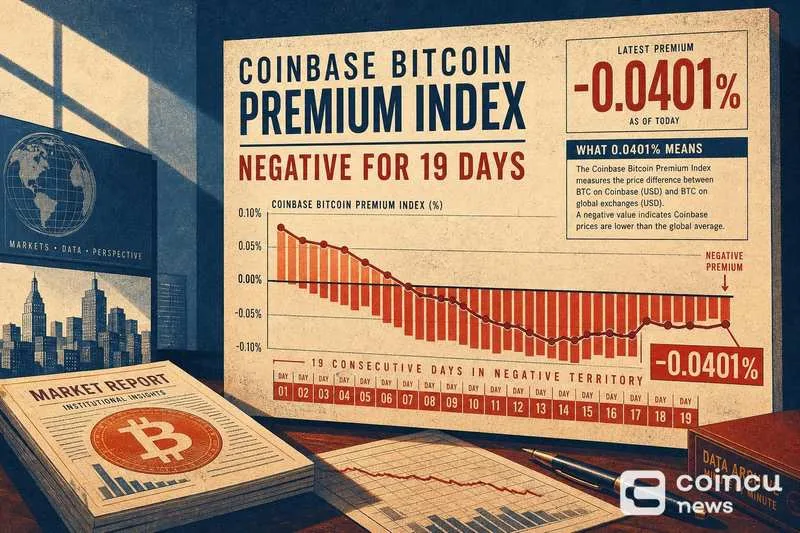
The Coinbase Bitcoin Premium Index has stayed below zero for 19 consecutive trading sessions, signaling that Bitcoin buyers on Coinbase are consistently paying slightly less than buyers on other major exchanges worldwide. The latest figure registers a modest discount of -0.0401%, reflecting ongoing subdued US spot demand relative to international markets.
This index tracks the price differential of Bitcoin on Coinbase against other global platforms. A positive reading typically reflects stronger institutional or retail buying pressure within the US, as Coinbase holds a leading position among American cryptocurrency exchanges. Conversely, its negative territory reveals softer US buying activity, meaning that demand from American traders is relatively weaker compared to offshore markets.

While a persistent negative premium does not guarantee a Bitcoin price drop, it provides insight into relative market sentiment and demand dynamics. Historically, periods where the Coinbase Premium dips below zero correspond to phases when US spot demand eases, though the impact on Bitcoin’s price is not always predictable. Analysts use this metric alongside other indicators, such as exchange reserves and large wallet transfers, to form a fuller picture of market flows and investor behavior.
The current streak’s significance lies in its duration rather than the size of the discount. Although the -0.0401% gap is small, its persistence over nearly three weeks indicates a structural shift rather than a temporary pricing anomaly caused by isolated events or liquidity mismatches. Temporary, larger single-day premiums or discounts can result from momentary disruptions; this sustained marginal negative gap points to ongoing factors dampening Coinbase demand.
Institutional movements continue to influence market dynamics independently of the premium index. For example, sovereign-level transactions like the recent transfer of hundreds of Bitcoins by the Bhutan government highlight how large-scale flows can impact exchange liquidity and pricing differentials apart from retail demand signals.