

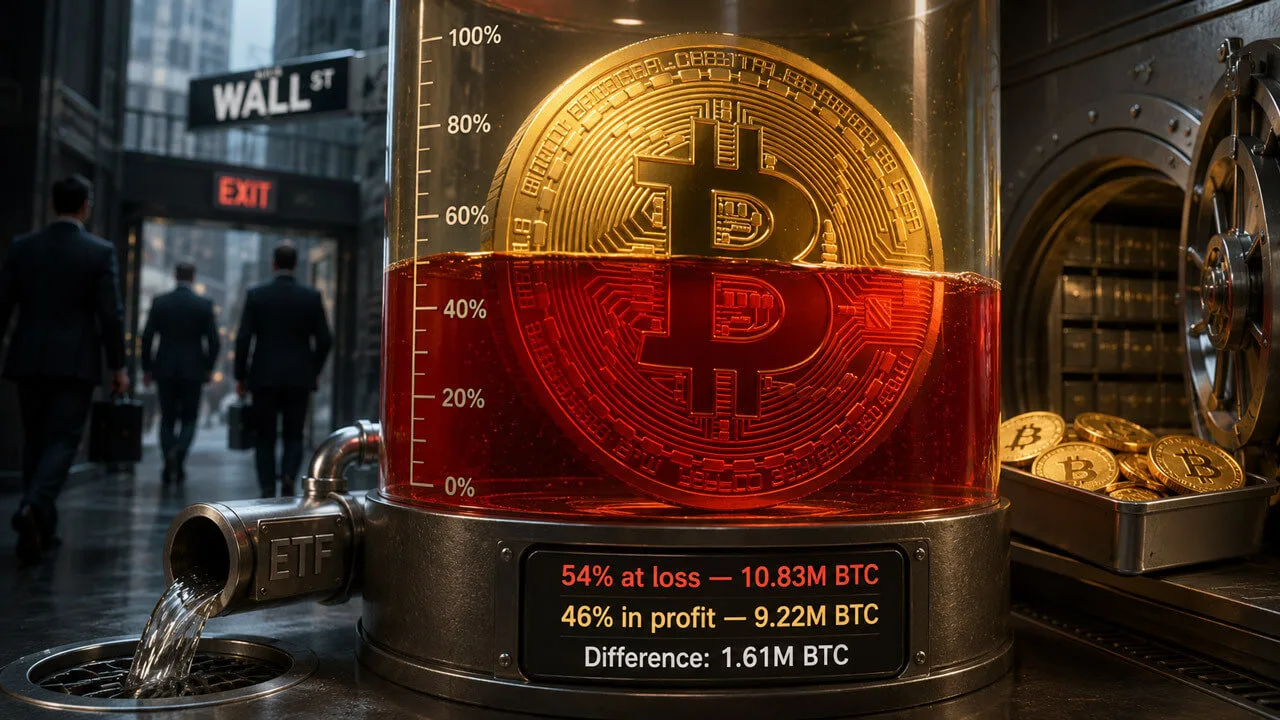
Bitcoin’s market dynamics are showing a notable divergence between institutional sellers and long-term investors. While Wall Street’s Bitcoin exchange-traded funds (ETFs) continue to record sustained net outflows, on-chain data reveals that experienced Bitcoin holders and a range of wallet sizes are steadily buying during the current market downturn.
Glassnode’s latest Week Onchain report highlights that over half of Bitcoin’s circulating supply—about 10.83 million BTC—is currently held at a loss, surpassing the 9.22 million BTC still held in profit. This marks a sharp decline in investor profitability, a condition historically linked with capitulation among newer investors and intensified selling pressure. The report describes this as one of the most significant deteriorations since the current bull run began, underscoring a psychological hurdle for price recovery.

Despite this pressure, market layers are shifting. Suffering coins previously sold off by less patient holders are now being absorbed by long-term investors, who have resumed net accumulation after a period of distribution. Notably, wallets holding less than 1 BTC and those holding between 100 and 1,000 BTC have demonstrated the strongest accumulation trends. Additionally, larger wallets in the 1,000-to-10,000 BTC range have recently transitioned back into net buying, broadening the pattern of accumulation across ownership tiers.
This behavior suggests a change in the Bitcoin buyer profile: patient, conviction-based capital is gradually taking control of supply that newer holders have offloaded. The modest pace of accumulation contrasts with previous cycles' buying volumes but signals an early bottom formation before any significant price confirmation. The mounting demand from small retail holders alongside mid-sized and large holders challenges the notion that only whales or institutional investors influence the market’s floor.
Meanwhile, the persistent outflows from regulated Bitcoin ETFs traded in the United States maintain downward price pressure. This dynamic helps explain why Bitcoin’s market value remains subdued despite growing on-chain signs of firm buying interest from long-term participants. The tension between ETF selling and patient accumulation appears to be shaping current price action.
Glassnode’s data thus paints a nuanced picture: while institutional de-risking through ETFs continues, the underlying Bitcoin supply is shifting steadily into the hands of holders reaffirming their confidence in the asset’s long-term value. This evolution in ownership and buying activity offers insight into market resilience amid ongoing volatility.