

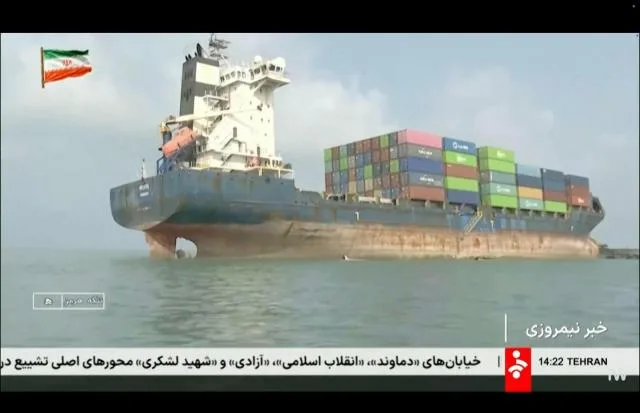
Iranian state media recently announced that a foreign container ship became stranded in the Strait of Hormuz after allegedly ignoring instructions from the Islamic Revolutionary Guard Corps (IRGC). The announcement emphasizes Tehran's assertion of control over this strategic waterway, critical for global oil and gas shipments.
However, detailed investigation reveals that the ship, identified as the Arista, is not foreign but tied to Iran. Marine tracking data confirms that the vessel has been immobilized near Hormuz Island, within Iran’s territorial waters, since mid-March. The Arista operates under a flagged identity linked to Comoros but was previously known as the Panama-flagged Gauja, a ship sanctioned by the U.S. Treasury for involvement in a large-scale oil smuggling network benefiting Iran’s elite.

Iranian state television’s footage showing the stranded ship blurred any identifying markings, leaving the vessel’s name and registration obscured. Independent experts matched the ship's distinctive paint and container colors to the Arista, corroborating its Iranian association. Tracking records also indicate that before becoming stuck, the Arista was regularly traveling between Hormuz and Asaluyeh, another Iranian port.
This incident coincides with ongoing tensions in the Strait of Hormuz, where Iran has leveraged control to exert pressure amid conflicts with the U.S. and Israel. Tehran’s insistence on using its designated maritime route, called the „Route of Authority,” further underscores efforts to regulate navigation through a critical chokepoint essential to global energy markets.
Earlier, the U.S. Treasury linked the Arista under its former name to a smuggling operation led by figures close to Iran’s ruling security establishment, illustrating the vessel’s role in circumventing international sanctions. Iran’s government and its United Nations mission have yet to respond publicly to inquiries about the incident.