

Tehran is gearing up for a long and elaborate funeral procession for the late Supreme Leader Ayatollah Ali Khamenei, marked by heightened security measures and the presence of top officials including General Ahmad Vahidi. This marks the first public appearance of Vahidi in months, underscoring his growing significance in Iran’s political and military spheres.
Photos released by Iranian state media showed General Vahidi attending a meeting dedicated to the funeral arrangements, followed by his presence beside Khamenei’s coffin during a smaller memorial held near the former residence of the supreme leader. Vahidi has been largely absent from public view since early February, weeks before the outbreak of intensified hostilities with the United States and Israel. His return signals a possible consolidation of power around figures deeply involved in shaping Iran’s hardline policies.

Experts highlight General Vahidi’s role within a closely knit group reportedly maintaining direct contact with Iran’s new Supreme Leader, Ayatollah Mojtaba Khamenei. Mojtaba remains largely out of public sight, believed to have been injured during Israeli airstrikes on February 28 that also claimed the life of his father, Ali Khamenei. These strikes, which targeted multiple Iranian officials, have left the country’s leadership under intense pressure amid ongoing threats against its command structure.
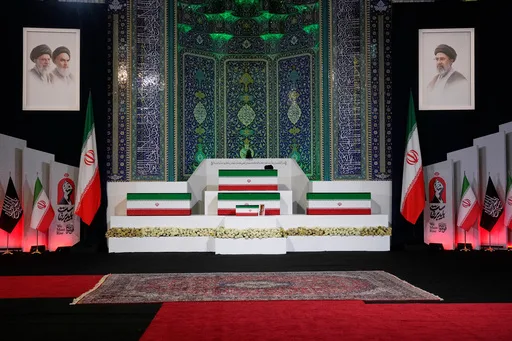
State media coverage of the funeral rituals displayed a scene steeped in Shiite symbolism. Khamenei’s coffin rested on a stage, decorated with red tulips—a symbol of martyrdom—and paper butterflies hanging from the ceiling. The mourners, mostly families affected by recent conflicts, performed traditional gestures such as brushing scarves against the coffin, reflecting deep cultural and religious mourning practices.
The coffin was later draped with a red flag inscribed with “Ya Hussein,” a Shiite invocation recalling the martyrdom of Imam Hussein, grandson of the Prophet Muhammad. This flag, previously displayed over the golden-domed shrine of Imam Hussein in Karbala, Iraq, embodies both the memory of unjust bloodshed and a call for retribution, resonating powerfully within Iran’s religious-political narrative.
On the morning following the initial ceremonies, Khamenei’s coffin, now covered with the Iranian national flag, was carried by security forces into Tehran’s Grand Mosalla. There, religious leaders, government officials, and international dignitaries paid their respects. The coffins of other family members who died in the war, including Khamenei’s 14-month-old granddaughter, Zahra Mohammadi Golpayegani, were also present.
Authorities have announced an extensive schedule of mourning that will spread over several days, including processions to multiple cities within Iran and neighboring Iraq. Tehran is expected to experience street closures, an airspace lockdown, and disruptions to daily life as the nation commemorates the passing of a leader who held power for decades through a blend of religious authority and political control.