

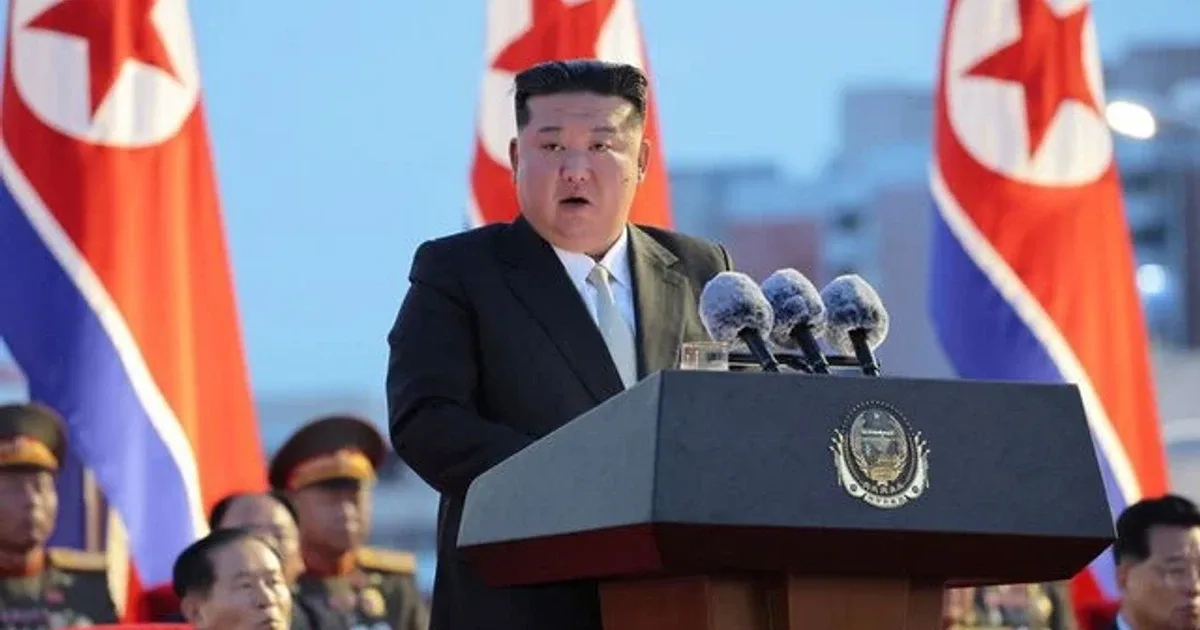
North Korea’s leader Kim Jong Un has reinforced that the country’s nuclear weapons program is no longer negotiable but an essential and enduring response to global insecurity. Speaking at the Workers’ Party of Korea’s plenary meeting, Kim portrayed nuclear capability as the only realistic option to manage a world marked by unpredictability and increasing military threats.
The remarks marked a clear shift away from earlier diplomatic engagement frameworks that centered on denuclearization. Instead, Kim positioned North Korea firmly as a nuclear-armed state, signaling a hardened stance against Washington and Seoul’s ongoing efforts to achieve denuclearization on the Korean Peninsula. This approach closes off avenues for talks that begin with Pyongyang giving up its nuclear arsenal.

During the same address, Kim criticized the United States for exacerbating conflicts in Europe and the Middle East and accused both Washington and Seoul of intensifying their combined nuclear capabilities. This rhetoric coincided with recent U.S.-South Korea diplomatic meetings, where officials reiterated their commitment to denuclearizing North Korea despite Pyongyang’s rejection of such efforts.
Kim also ordered accelerated military developments, including speeding up construction of a large strategic guided-missile cruiser and expanding conventional forces. He explicitly mentioned South Korea’s plans to acquire a nuclear-powered submarine as justification for North Korea to continue enhancing its own military capabilities.
The setting of Kim’s speech, delivered inside a high-level Central Committee plenary session, served both to communicate firm policy priorities to the ruling party and to signal foreign governments that Pyongyang’s nuclear policy will not soften. This public articulation affirms that North Korea intends to negotiate only on the basis of being recognized as a nuclear state, which would narrow discussions toward arms reduction linked to sanctions relief and revamped diplomatic relations.
Experts note that North Korea’s shift from denuclearization talks to seeking parity as a nuclear power represents a major recalibration in its foreign policy, demanding new strategies from Washington, Seoul, and the international community to address the evolving security environment.