

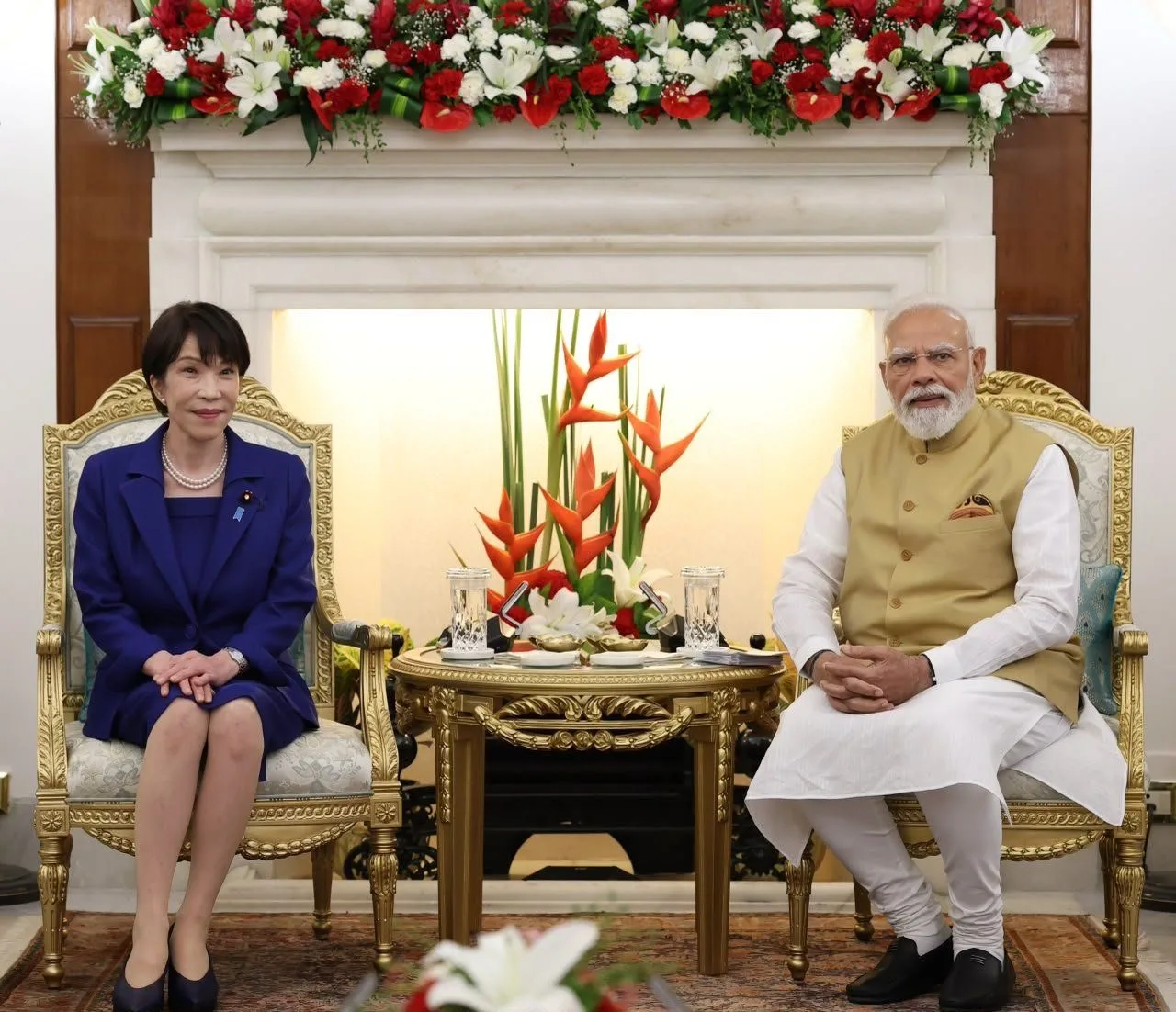
During their meeting in New Delhi, Prime Minister Narendra Modi and Japanese Prime Minister Sanae Takaichi expressed significant concern about the escalating tensions and militarization in the East and South China Seas. Both leaders condemned unilateral actions that threaten the freedom of navigation and overflight, emphasizing the need to maintain the existing status quo without coercion or force.
The leaders reaffirmed their commitment to resolving maritime disputes peacefully through adherence to international law, particularly the United Nations Convention on the Law of the Sea (UNCLOS). They highlighted the dangers of increasing military presence around disputed features and stressed that such actions undermine regional security.

On the security front, Modi and Takaichi voiced serious apprehension regarding North Korea’s ongoing nuclear and missile programs. They reiterated the importance of full denuclearization aligned with United Nations Security Council resolutions and called upon all UN member states to enforce sanctions strictly, including arms embargoes related to North Korea. Both leaders also reiterated the urgent need to address the issue of abducted individuals, underscoring the necessity for a swift resolution.
The joint statement also addressed regional conflicts beyond East Asia. Both leaders expressed concern over Myanmar’s internal strife and its wider impact, urging an immediate halt to hostilities. They called for an inclusive dialogue process led and owned by Myanmar’s stakeholders to achieve lasting peace.
Turning to the Middle East, Modi and Takaichi reaffirmed their commitment to sustainable peace and stability, highlighting the critical need for secure and open navigation through the Strait of Hormuz to protect energy and essential supply chains. They stressed upholding international law as per UNCLOS and emphasized advancing reconstruction plans for Gaza, alongside supporting a two-State solution to resolve the Israeli-Palestinian conflict via diplomatic efforts.
Finally, the Indian and Japanese leaders expressed their support for a just and lasting peace in Ukraine, based on international law and the UN Charter, welcoming ongoing diplomatic initiatives aimed at ceasing hostilities and restoring stability in the region.