

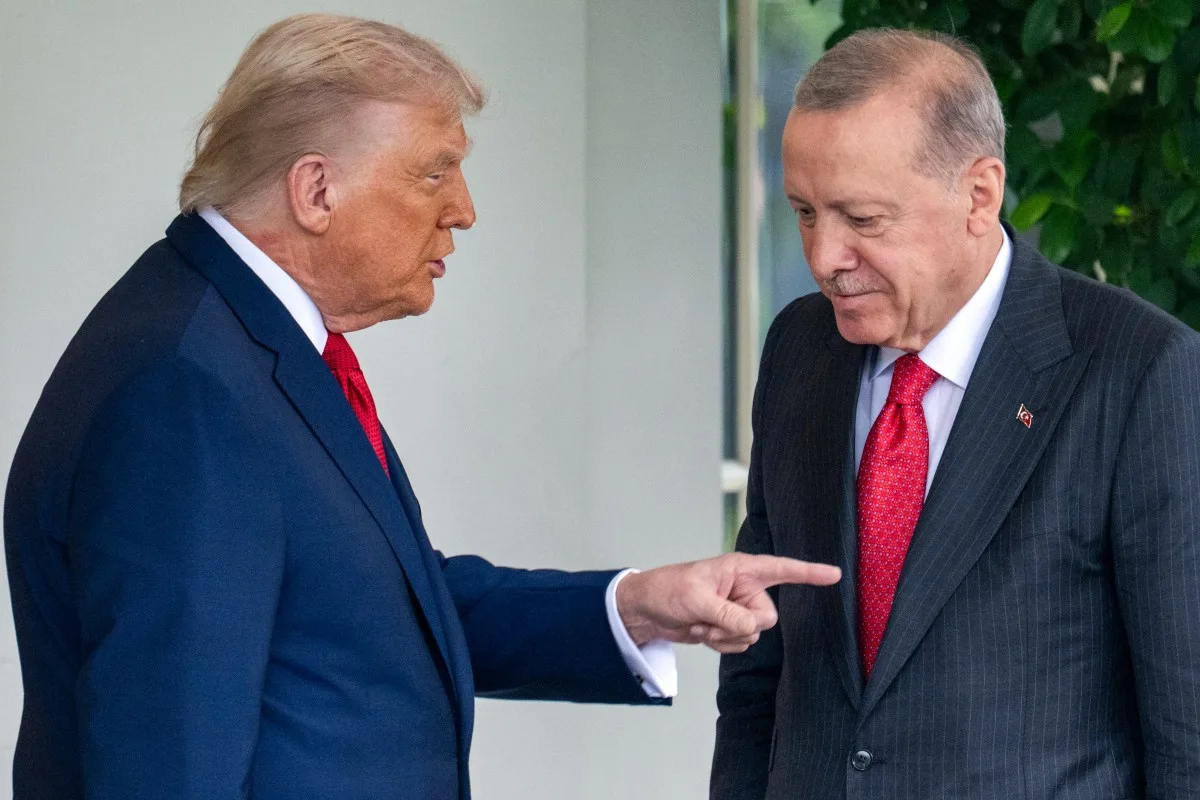
US President Donald Trump’s scheduled trip to Ankara coincides with a potential breakthrough in Turkey’s quest for advanced fighter jet engines needed to advance its indigenous stealth fighter program. While Turkey will likely gain access to the coveted F-110 engines during the NATO summit, the longstanding dispute over Turkey’s exclusion from the F-35 program is set to remain a contentious issue.
The F-110 engines, manufactured by General Electric, are vital to Turkey’s KAAN project, a twin-engine stealth fighter developed by Turkish Aerospace Industries as part of Ankara’s ambition to modernize its air force and join a select group of nations with fifth-generation combat aircraft. Turkey previously received a limited batch of these engines but has faced obstacles in procuring more due to US political constraints linked to Ankara’s acquisition of the Russian S-400 missile defense system.

Turkey has built and successfully flown prototypes equipped with the F-110 engines but still awaits approval to import additional units necessary to increase the KAAN fleet. The Turkish defense establishment hopes that the NATO summit, hosted by President Recep Tayyip Erdogan, will remove congressional barriers and greenlight the sale of roughly 40 more F-110 engines. This would mark a significant easing of a bottleneck hampering Turkey’s indigenous fighter production.
Despite these expected advancements, the F-35 program remains a separate and unresolved matter. Turkey was expelled from the US-led F-35 project in 2019, following its 2017 purchase of the Russian S-400 air defense system, leading to sanctions under the Countering America’s Adversaries Through Sanctions Act (CAATSA) that have severely strained bilateral defense relations. Negotiations over the future of the F-35 and related sanctions have stalled, reflecting deep mistrust between the two NATO allies.
In the meantime, Turkey is pressing forward with plans to develop a fully domestic engine variant for the KAAN fighter. However, this indigenous engine is still in the preliminary design phase and lacks stealth capabilities, underscoring the importance of acquiring US-supplied F-110 engines in the short term. Turkish officials have described ongoing talks to secure additional engines, but final approval hinges on US congressional clearance.
Turkey’s efforts illustrate a broader shift toward defense self-reliance amid deteriorating ties with Washington. The push to field the KAAN fighter reflects Ankara’s intent to reduce dependence on foreign technology, even as it seeks to resolve political obstacles to acquiring critical components abroad.