

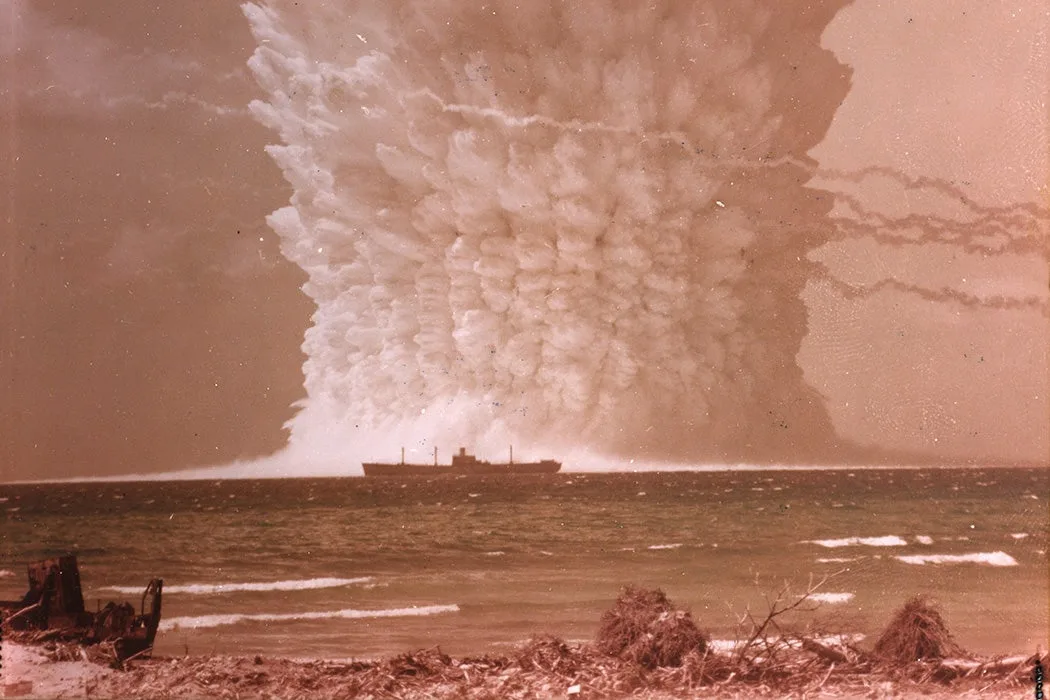
The atomic detonations carried out by the United States at Bikini Atoll in 1946, known as Operation Crossroads, were not only historic military events but also marked a turning point in oceanographic science. The following year, a team of Navy-backed scientists returned for the Bikini Scientific Resurvey, conducting extensive underwater investigations that validated long-standing geological theories about coral atoll formation.
At the heart of the expedition was an ambitious effort to test Charles Darwin’s hypothesis that atolls form through coral growth around sinking volcanic islands. Scientists drilled a deep borehole reaching over 2,500 feet, uncovering fossils of corals, algae, foraminifera, and mollusks at various depths. These findings confirmed Darwin’s model, showing that the reef structure developed progressively as the volcanic base subsided. This interdisciplinary research required combining biology, geology, and geophysics with advanced instruments such as seismic testing equipment and the "1500 Holemaster" drill, operated around the clock by the research team.

This effort reflected a broader evolution in oceanography during the mid-20th century. Before World War II, oceanography was viewed as a multifaceted study of the oceans rather than a distinct discipline. Institutions like the Scripps Institution of Oceanography and the Woods Hole Oceanographic Institution fostered collaboration across fields. The growing strategic interests of the US Navy, particularly for submarine detection and naval navigation, deepened military support for oceanographic research, enabling scientists to gain more autonomy in designing their studies.
The Bikini Scientific Resurvey exemplified this shift by giving scientists greater control over equipment selection and research priorities compared to earlier military-led operations. Collaboration with the U.S. Geological Survey allowed for the integration of diverse technological methods, including surface and subsurface mapping tools like sonar and radar. These innovations not only served immediate military purposes but also laid the groundwork for systematic ocean exploration and the development of accurate navigational charts.
Beyond validating scientific theories, the expedition demonstrated the emerging symbiosis between military funding and scientific inquiry. The involvement of figures like Roger Revelle, who directed naval oceanographic research during and after the war, highlights how defense priorities shaped the growth of oceanography as a specialized field. The Bikini Atoll tests thus represent a pivotal moment when nuclear technology indirectly propelled advances in marine science, transforming both disciplines.