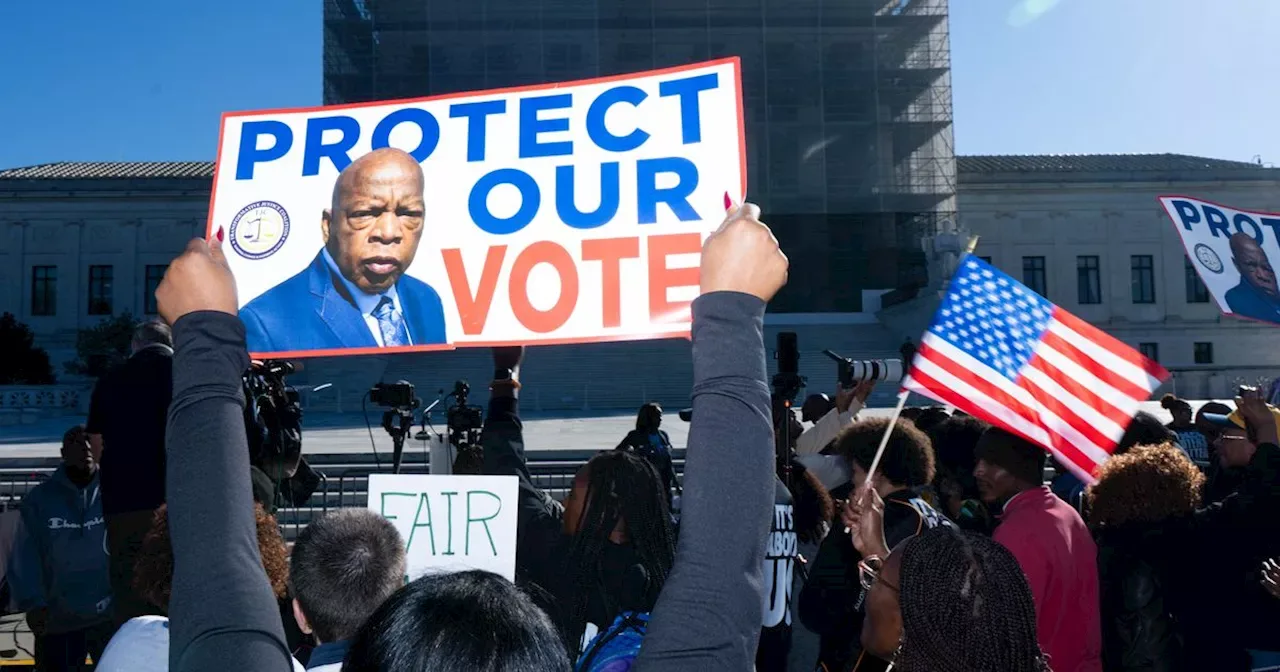
A Supreme Court decision has dismantled key voting rights protections, leaving Democrats to explore potential responses if they regain congressional control and the presidency. The ruling, which struck down the implementation framework of the Voting Rights Act, has handed significant advantage to Republicans, particularly in former Confederate states where the VRA previously safeguarded minority voting interests.
The decision does not explicitly eliminate the VRA itself, but it declared that the previous enforcement mechanisms were unconstitutional. This shift creates a fundamental challenge for Democratic legislative efforts: the John Lewis Voting Rights Advancement Act, one of two major voting rights measures Democrats advanced in 2021, may now face insurmountable judicial obstacles even if it reaches a Democratic president's desk. The Court's reasoning—that race-conscious remedies for discriminatory redistricting are themselves unconstitutional—makes VRA repair legislation unlikely to withstand judicial review.

Democrats' other 2021 voting rights bill, the For the People Act, pursued a different approach by focusing on race-neutral election standards. That legislation proposed automatic voter registration, uniform early voting, voter roll protections, and independent redistricting commissions to prevent partisan gerrymandering. Because these provisions avoid explicit race-consciousness, legal experts suggest they might have a stronger chance of surviving judicial scrutiny than race-focused remedies.
The GOP previously argued that such national election standards violated states' traditional role in election administration. Republicans may find that argument harder to sustain, however, given their recent support for Trump-led efforts imposing national election rules on states.
When Democrats held unified control of Congress in 2021, the House passed both voting rights measures, but they died in the Senate. Two Senate Democrats blocked elimination of the filibuster for voting rights legislation. Those senators are no longer in the chamber, potentially opening a path for future Democratic majorities to bypass the filibuster if they choose to do so.
Beyond federal legislation, Democrats could focus on protecting voting rights at the state level through their own redistricting measures while monitoring Republican efforts to suppress minority voting interests in states they control.