

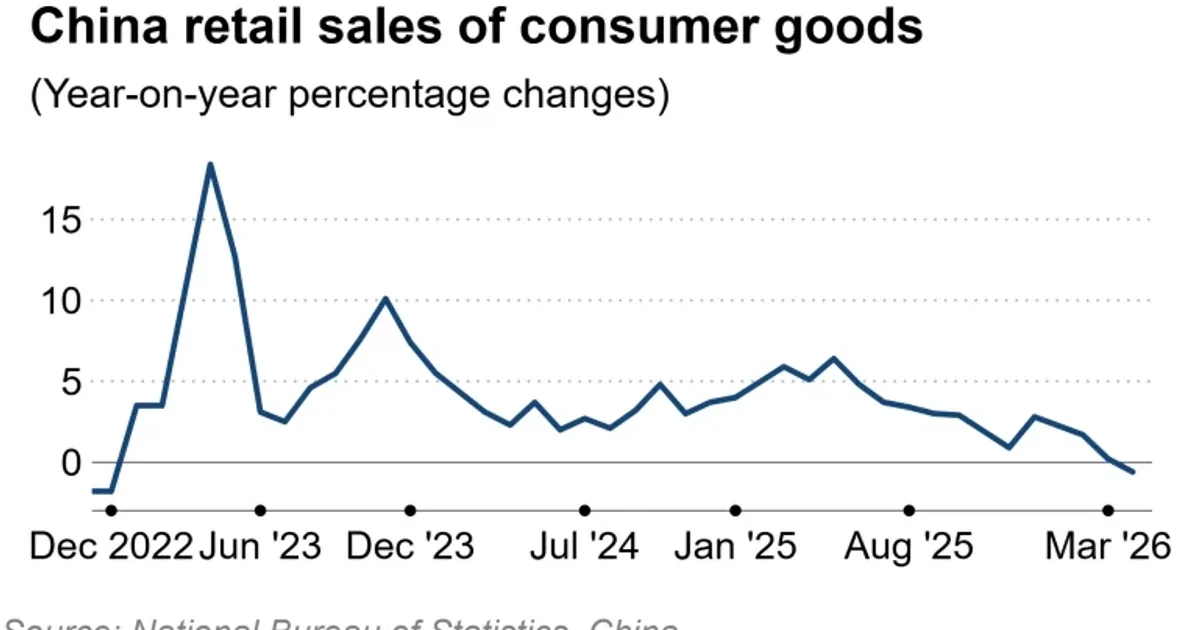
China experienced a decline in retail sales in May, marking the first annual fall since December 2022. The 0.6% drop highlights subdued household spending, even as the manufacturing sector remains active thanks to robust export demand. This divergence in economic drivers exposes growing imbalances in China’s recovery path.
While retail sales fell compared to the previous year and reversed April’s modest gain, total consumer goods and services retail sales still grew year-to-date. The National Bureau of Statistics reported a cumulative increase over the first five months of the year, but the monthly slowdown signals cautious consumer behavior amid fading government stimulus efforts.

Industrial production painted a different picture, rising steadily as external demand supported factory activity. Output grew 4.5% in May, accelerating from April’s 4.1% growth, underscoring the growing reliance on exports to drive economic momentum. However, domestic challenges remain significant. Fixed-asset investment declined sharply in the first five months, driven by an ongoing slump in real estate, an important sector for household wealth and local revenues. Real estate investment fell over 16%, and new home sales dropped nearly 11%, dampening consumer confidence further.
The labor market showed little improvement. Urban unemployment in May was slightly lower than April but remained elevated enough to weigh on household spending power. Officials acknowledged that while the overall economy stayed broadly stable, foundations for steady growth need reinforcement, indicating concern over the fragile domestic demand.
Analysts point to the waning impact of consumer subsidies and weak household confidence as primary factors behind the retail slump. The expanding gap between healthy export figures and soft domestic consumption presents a policy challenge ahead. Beijing faces pressure to maintain its growth target for the year. Should consumption fail to rebound, further stimulus measures may become necessary even as the export sector continues to shoulder much of the economic burden.