

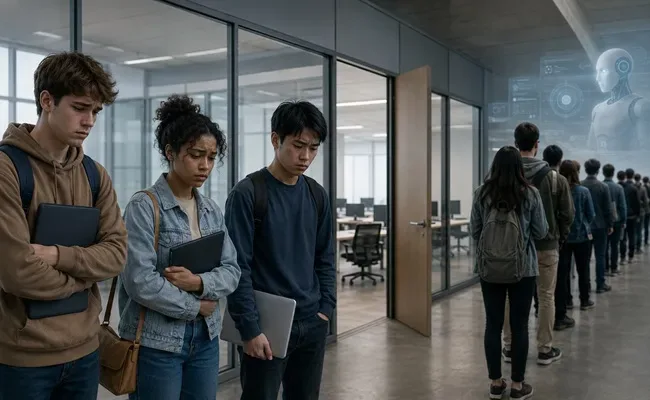
Young workers in the United States face a job market constrained more by a scarcity of available positions than by their ability to adapt to artificial intelligence technologies. Research from the Federal Reserve Bank of St. Louis highlights that the primary factor behind the rising unemployment rate among 18- to 24-year-olds is the lack of job openings rather than displacement due to AI-driven roles.
The study quantifies this disparity, showing that job scarcity increased unemployment in this age group by nearly three percentage points. In contrast, the shift towards AI-related employment accounts for a smaller, roughly one-point increase. This suggests that although AI is reshaping certain industries, the overarching challenge for young adults seeking employment remains the tightness of the labor market for entry-level positions.

This dynamic extends even to recent college graduates, many of whom are actively gaining AI skills and certifications in hopes of enhancing their employability. However, such efforts may not fully overcome the fundamental barrier posed by a shortage of hiring opportunities. Consequently, the narrative placing AI solely as the disruptor of youth employment appears incomplete.
Instead, the findings point to a broader economic issue where fewer companies are onboarding new, inexperienced workers. Addressing youth unemployment, therefore, requires focusing on expanding job availability alongside skill development initiatives.