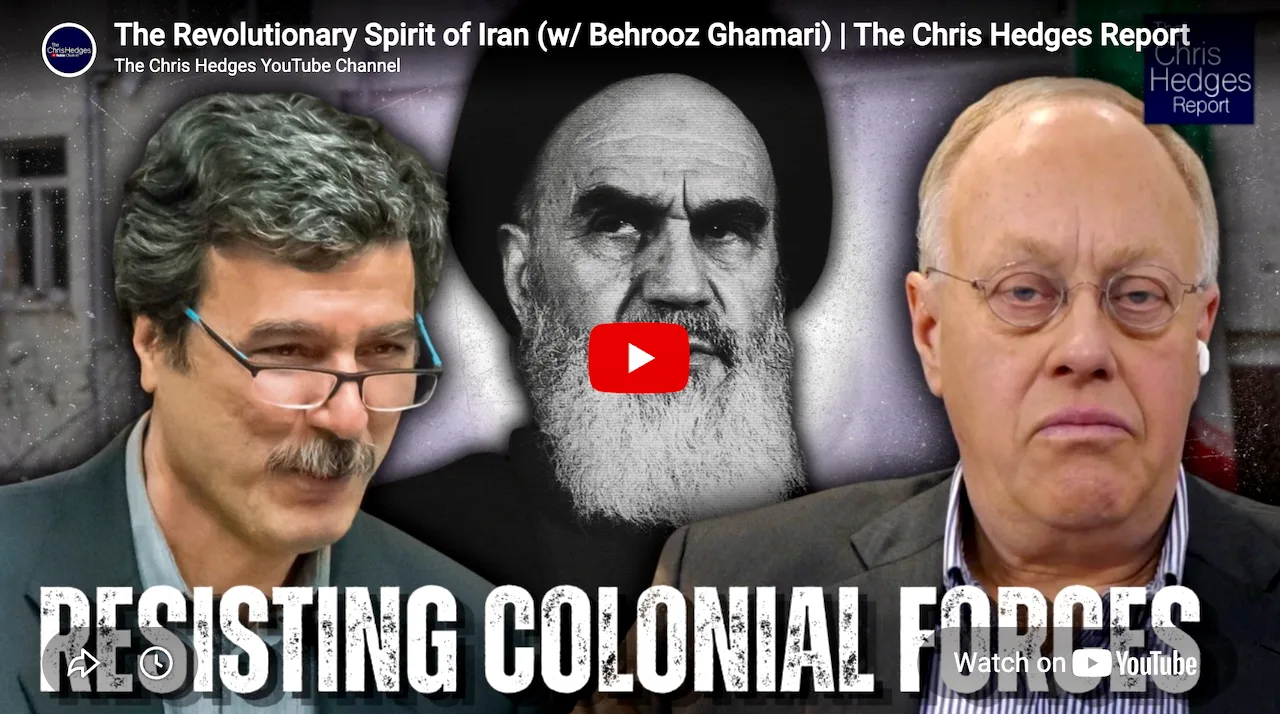
In an interview with journalist Chris Hedges, Professor Behrooz Ghamari-Tabrizi, author of "The Long War on Iran: New Events, Old Questions," argues that Western decision-makers have fundamentally miscalculated the effects of sanctions and military strikes on Iranian society. Rather than inciting the population against their government, he contends, such pressure has strengthened national cohesion and empowered repressive state forces.
Ghamari-Tabrizi, a visiting scholar at the Center for Place, Culture and Politics at the CUNY Graduate Center, traces the roots of current tensions to 1953, when the United States and United Kingdom orchestrated a coup against democratically elected Prime Minister Mohammad Mossadegh. That intervention, Ghamari-Tabrizi argues, fundamentally shaped Iranian consciousness and directly led to the 1979 revolution—which he describes as "the largest, most populous revolution in world history" that defeated the fifth largest military in the world at that time.

The professor explains that Western sanctions operate on a flawed premise: that economic pressure will prompt citizens to overthrow their own government. In practice, he argues, sanctions impoverish all social classes, securitize society by strengthening security forces, and create opaque economic networks ripe for corruption. Rather than weakening state authority, such measures entrench it.
Ghamari-Tabrizi emphasizes that Iran harbors legitimate historical grievances. During the eight-year war with Iraq, the United States supplied chemical weapons materials and means of delivery, while vetoing United Nations Security Council resolutions condemning Iraqi chemical weapons use. More recently, Iran assisted the United States in overthrowing the Taliban in Afghanistan, only to be branded part of the "Axis of Evil" by President George W. Bush—a betrayal that devastated Iran's reformist movement and destroyed hopes for rapprochement.
The scholar argues that every U.S. policy toward Iran, despite stated objectives of promoting democracy, has actually undermined democratic elements within Iranian society. Iranians, he contends, have sound reasons for skepticism about American intentions and the burden of rebuilding trust falls on the United States, not Iran.
Ghamari-Tabrizi draws parallels to Cuba, noting that decades of embargo have only empowered ruling classes while immiserating ordinary citizens. He argues that free trade, open communication, and normal political relations create better conditions for democratic movements than isolation and coercion.
The core dispute, according to Ghamari-Tabrizi, centers on Iran's sovereignty. The Islamic Republic refuses to become a client state aligned with American interests, a stance that has defined U.S.-Iranian relations for nearly half a century. The current conflict, he suggests, represents a struggle over whether Iran will retain independent regional authority or submit to external pressure to reshape the Middle East according to Western and Israeli preferences.