

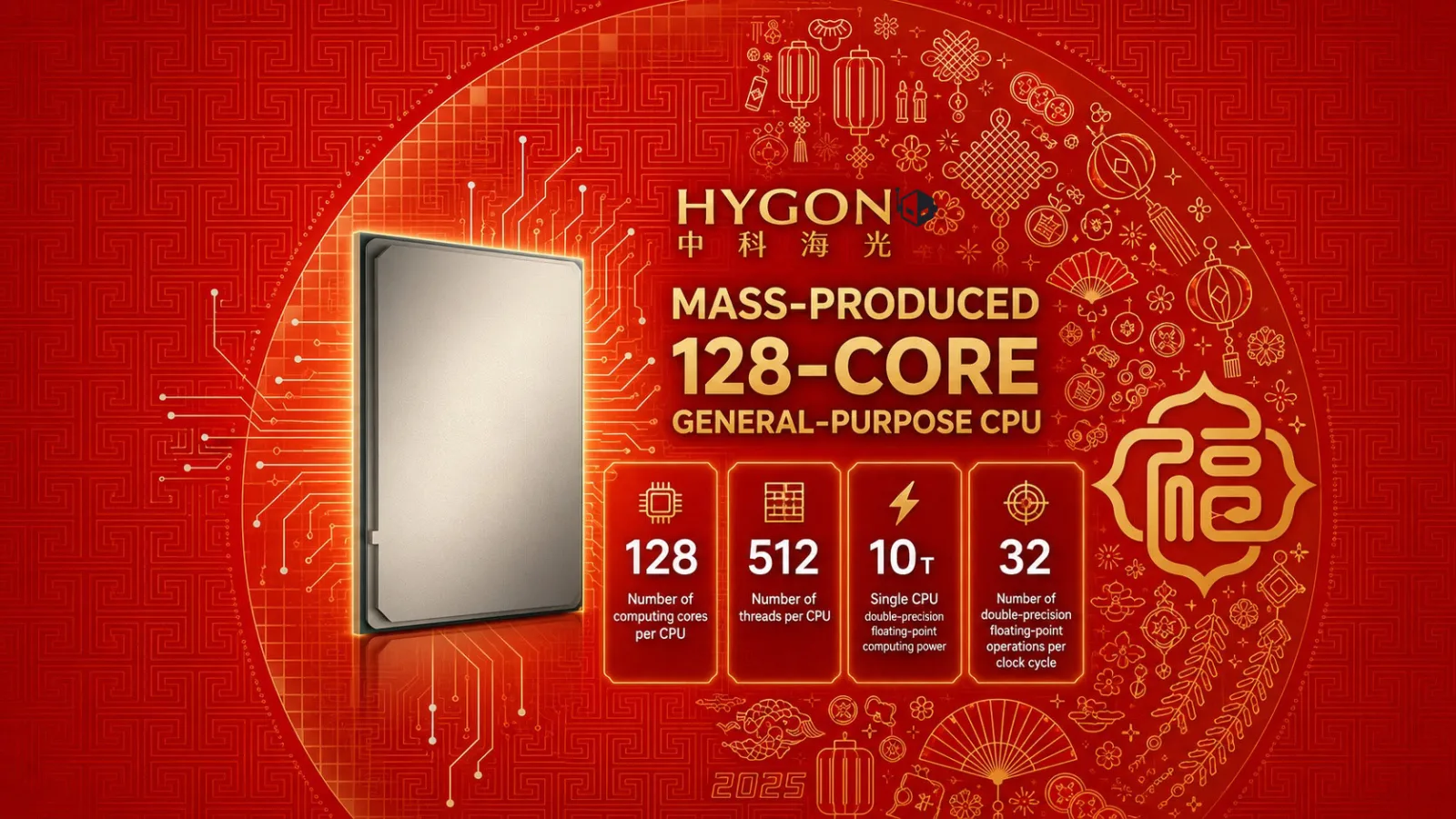
Hygon, a leading Chinese semiconductor company, has revealed plans for a groundbreaking next-generation C86 CPU designed to compete with Intel’s Xeon processors. The new chip features up to 128 cores and supports 512 concurrent threads through advanced SMT4 multithreading technology, marking a significant leap in domestic computing power.
The latest C86 series promises a microarchitecture overhaul with a claimed over 15% increase in instructions per clock (IPC) compared to previous models. This upgrade will enable the chip to handle high concurrency workloads typical of data centers and enterprise servers more efficiently. Its compatibility with the AVX512 instruction set enhances vector computing, while newly integrated AI acceleration instructions like INT8 and BF16 target machine learning and inference tasks.

Hygon asserts that this processor will deliver about 10 teraflops of FP64 floating-point performance, putting it on par with Intel’s Xeon 6 series. The platform also offers extensive input/output capabilities with 104 PCIe 5.0 lanes, which could lessen dependency on external PCIe switch suppliers such as Broadcom.
The company is already mass producing the initial batch of these cutting-edge chips. Corresponding server offerings include air-cooled dual-socket rack servers, fanless liquid-cooled high-density cabinets, and immersion phase-change liquid-cooled ultra-high-density units capable of hosting tens of thousands of CPU cores in aggregate.
Beyond CPUs, Hygon is advancing GPU development aimed at AI and high-performance compute workloads. Its upcoming “DCU” GPU accelerator supports full-precision GPGPU architecture and incorporates ultra-high-speed interconnects along with cutting-edge HBM memory technology. The GPU is designed to compete with NVIDIA’s Ampere-based A100, providing FP64, FP16, and BF16 precision support critical for AI training and scientific simulations.
This release underscores China’s strategic push to build a self-reliant semiconductor ecosystem capable of meeting domestic and industrial demand, reducing dependence on foreign technology giants in essential computing infrastructure.