

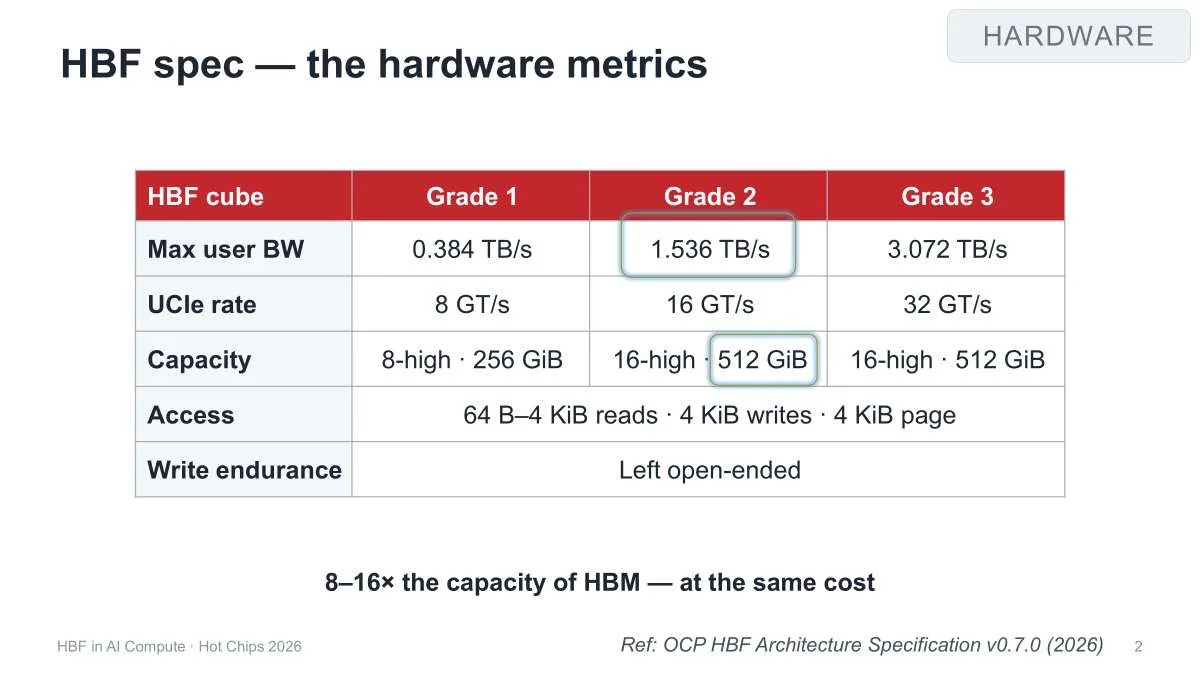
At Hot Chips 2026, Oxmiq Labs unveiled its High-Bandwidth Flash (HBF) solution, positioning it as a promising hardware tier to enhance AI inference performance. The company argued that HBF can deliver both the capacity and speed necessary to complement existing AI compute resources, addressing limitations found in current memory and storage hierarchies.
The presentation highlighted how HBF bridges the gap between high-speed memory and traditional storage by offering faster access to larger data volumes. This technology targets AI workloads with intensive inference demands that require handling substantial model parameters or datasets without compromising latency.

Oxmiq Labs made a case for integrating HBF within AI hardware stacks to improve system throughput and energy efficiency. While conventional DRAM and cache memory provide speed, they often fall short on capacity, and persistent storage solutions lag on bandwidth. High-Bandwidth Flash offers a middle ground, enabling AI systems to maintain rapid data flow with expanded storage pools.
The discussion also underscored broader trends in AI hardware design, where expanding model sizes drive the need for tiered memory architectures. Incorporating a capacity tier based on flash memory reduces pressure on more expensive, power-hungry components while maintaining responsiveness vital for inference.
Oxmiq Labs’ approach aligns with industry efforts to diversify AI compute infrastructure beyond GPUs and specialized accelerators. By focusing on storage-class memory innovations like HBF, the company aims to unlock scalable paths for deploying large AI models efficiently.
This presentation reflects a growing recognition that addressing AI inference bottlenecks requires novel hardware layers, balancing cost, power, and performance. Oxmiq Labs’ contribution offers a glimpse into how emerging flash technologies could reshape future AI system architectures.