

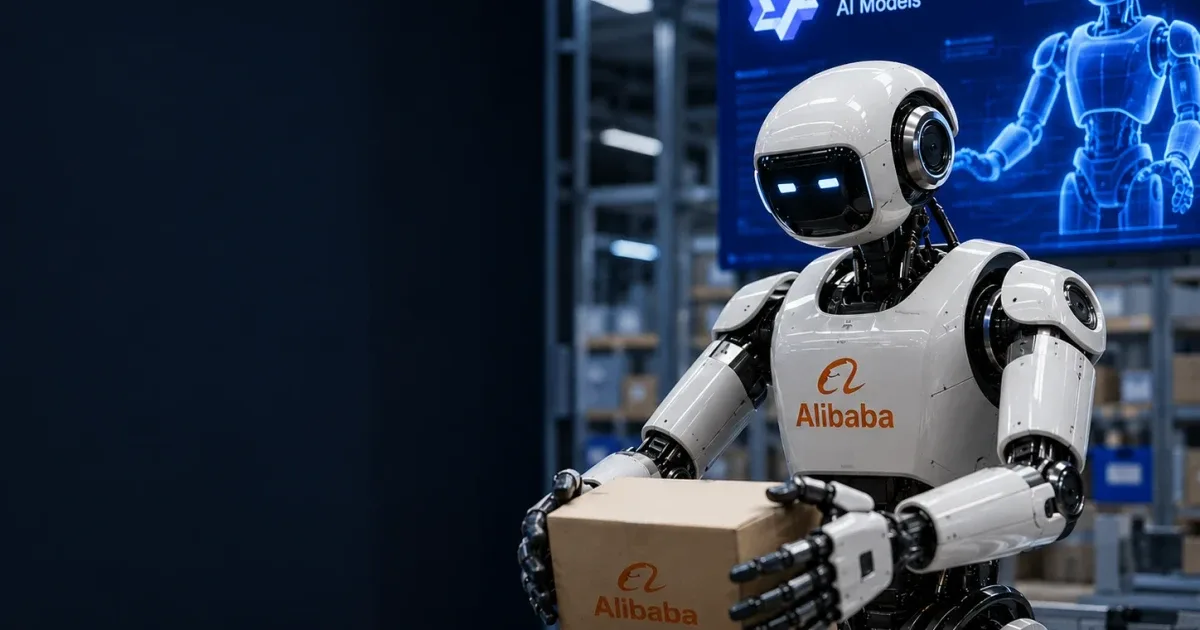
Alibaba is advancing beyond consumer-facing chatbots by launching its initial suite of AI models tailored for robots, marking a significant step toward intelligent agents that operate in factories, warehouses, and service environments. This development aligns with a broader Chinese focus on embedding AI into physical machines to perform complex tasks autonomously, going beyond simple conversational capabilities.
The company’s newly introduced models aim to enable robots to perceive and interact with the physical world, managing real-time operations within industrial and logistical settings. These AI systems are designed to execute decision-making processes and complex workflows, allowing integration across devices, software, and industrial infrastructures. The move reflects a shift in China’s AI competition, emphasizing agents that drive automation rather than solely refining user interfaces.

Earlier this year, Alibaba introduced multiple AI innovations including Qwen3.6-Plus, a model optimized for agentic coding and multimodal reasoning, which was integrated into Wukong, an enterprise AI platform geared toward automating sophisticated business processes with multiple AI agents. The release of Qwen3.7-Max and the Zhenwu M890 AI chip further enhanced processing power, with the chip delivering triple the performance of its predecessor. Alongside these models, Alibaba launched a reimagined cloud infrastructure supporting autonomous AI agents through platforms like the Panjiu AL128 Supernode Server and the Bailian model service platform, which incorporates reinforcement learning to improve agent task execution continuously.
This innovation wave coincides with China's industrial strategy outlined in its 15th Five-Year Plan, which prioritizes robotics as a key growth area for 2026-2030. Currently, China operates a large base of industrial robots, estimated at around 2 million units, significantly surpassing Japan’s total and providing a vast domestic ecosystem for testing embodied AI technologies. These range from robotic arms on assembly lines to autonomous warehouse systems, creating fertile ground for implementing Alibaba’s AI models.
In parallel, China has introduced its first national standard system for humanoid robots and embodied AI, developed through collaboration among over 120 research institutions and industry participants under the Ministry of Industry and Information Technology’s technical committee. The framework addresses the entire industrial cycle, emphasizing application, safety, and ethical standards, signaling the government’s intent to regulate and support the responsible growth of intelligent robotics within the nation’s industrial fabric.