

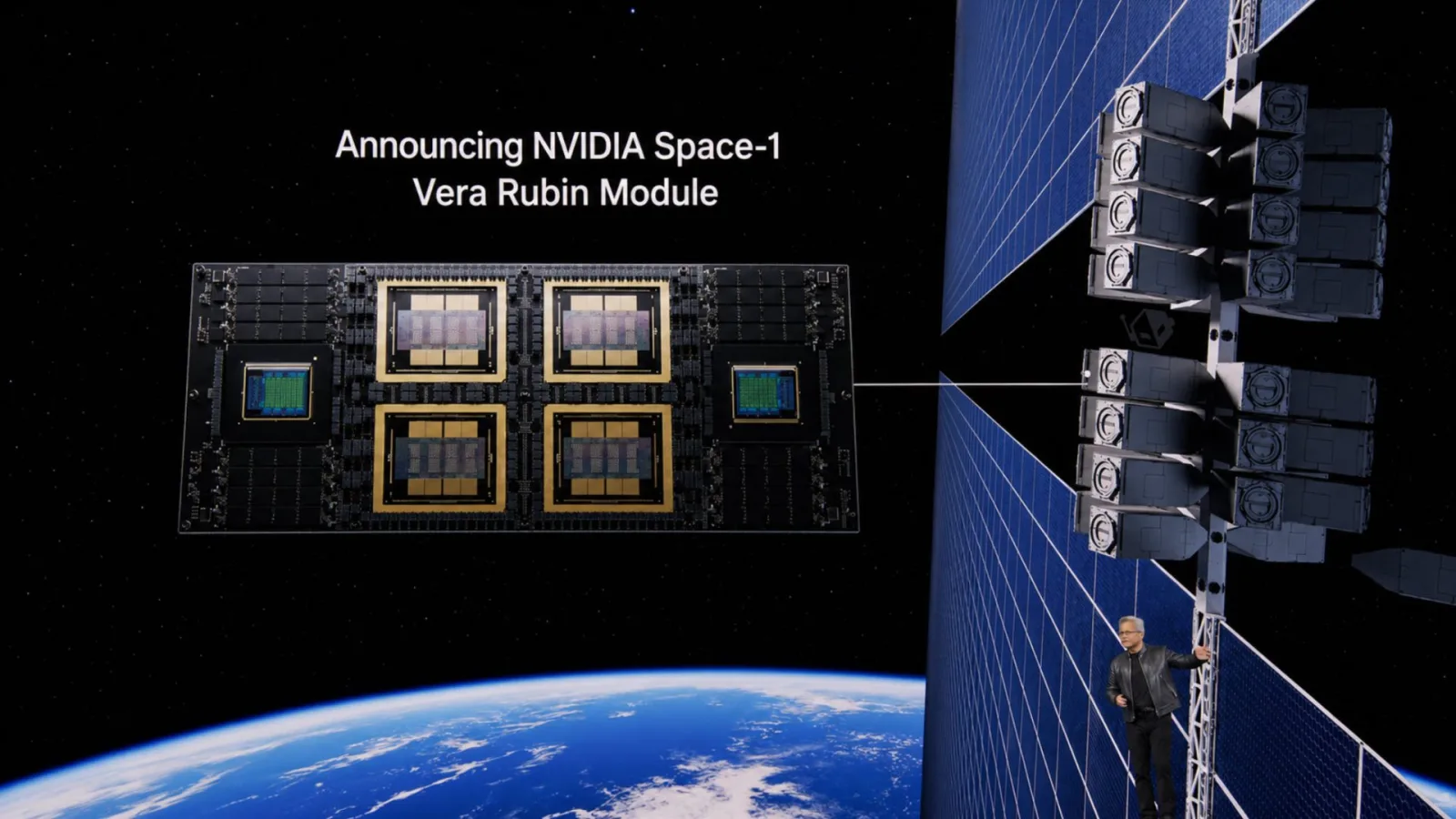
NVIDIA is advancing plans to place artificial intelligence data centers in outer space, addressing the growing physical and environmental limitations faced by terrestrial facilities. Collaborating with five specialized space companies, the tech giant intends to build orbital data centers that leverage solar energy and the natural vacuum of space for cooling, promising a more sustainable and efficient infrastructure for AI workloads.
The move comes amid increasing challenges for Earth-based data centers, which demand enormous power and water resources, straining local environments and communities. Current AI facilities require costly construction and intensive cooling systems, contributing to rising energy costs and ecological concerns. In contrast, orbital data centers could dramatically reduce these pressures by tapping into unlimited solar power and space’s near-zero temperature conditions.

NVIDIA’s Space-1 Vera Rubin module, designed specifically for space deployment, showcases this vision. This system integrates GPUs and CPUs tightly, delivering significantly higher AI computing power—reportedly up to 25 times that of previous generation models—for on-orbit applications. The module supports real-time AI tasks such as geospatial intelligence, autonomous space operations, and on-orbit data analysis powered exclusively by solar radiation.
The five partner companies involved in NVIDIA’s orbital AI initiative are Starcloud, Planet Labs, Kepler Communications, Firefly Aerospace, and Sophia Space. These collaborators bring expertise ranging from satellite deployment and space communications to aerospace engineering, supporting NVIDIA’s ambition to establish data centers beyond Earth. This alliance underpins a broader industry interest in expanding digital infrastructure off-planet as terrestrial limits become increasingly binding.
Last year, NVIDIA announced Starcloud’s planned launch of an AI-equipped satellite designed to orbit Earth, signaling the company’s commitment to space-based AI infrastructure. The envisioned orbital data center spans several square kilometers with super-large solar panels supplying power, aiming to deliver an energy cost reduction by a factor of ten compared with equivalent Earth-based installations.
As commercial space transportation technologies, like SpaceX’s Starship and Falcon Heavy, mature, the cost and feasibility of such projects improve. These developments position outer space as a new frontier for scaling AI computing capacity in a manner that could address critical environmental and resource challenges linked to data center expansion on Earth.