

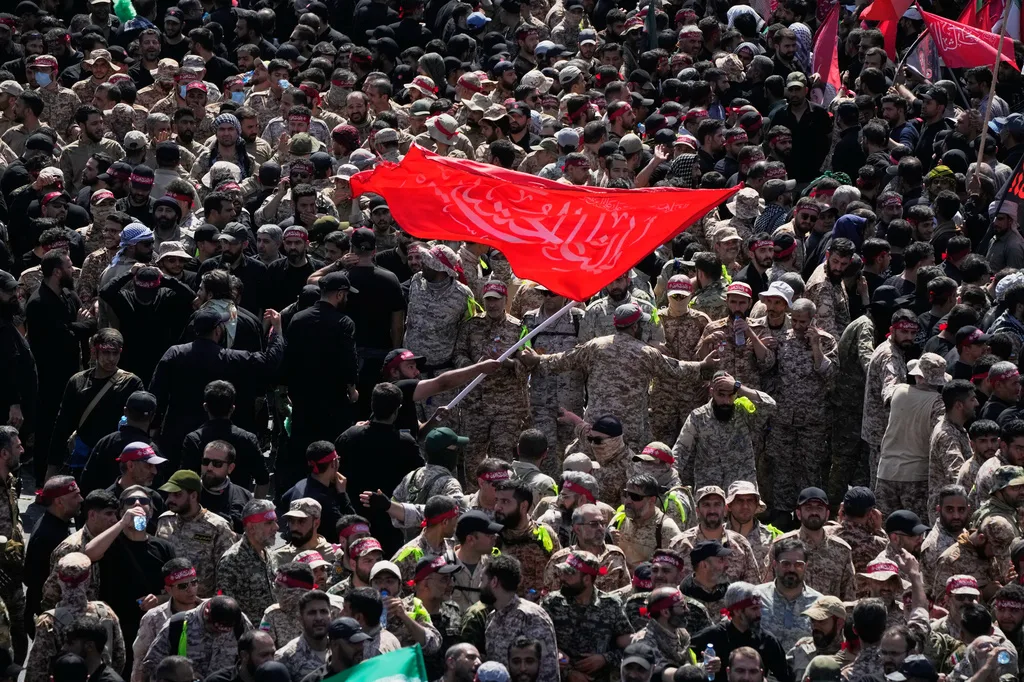
Tehran witnessed an immense outpouring of grief as thousands of mourners flooded the streets in black attire to honor the late Supreme Leader Ayatollah Ali Khamenei. His coffin, draped in the national flag alongside those of his family members killed in the same attack, was carried through the capital, drawing a crowd larger than the funeral of General Qassem Soleimani in 2020.
The coffins were transported on a truck adorned to resemble the ornate grille encasing a revered imam’s shrine, moving slowly from Islamic Revolution Square toward Azadi (Freedom) Square. Helicopter footage broadcast by Iranian state media showed throngs stretching for kilometers along the multi-lane Azadi Street, signaling both mourning and political resolve amid ongoing tensions with the United States and Israel.

The airstrike that killed Khamenei and his family on February 28 marked a sharp escalation in the conflict that has embroiled Iran with its adversaries. Demonstrators carried banners and chanted slogans calling for the death of then-U.S. President Donald Trump, reflecting deep-seated hostilities and the theocratic regime’s efforts to portray the funeral as a symbol of strength.
Many mourners reached out to touch the procession truck or threw scarves toward the coffin—a customary gesture believed to impart blessings in Shiite tradition. Members of the Islamic Revolutionary Guard Corps, waving Shiite religious flags, accompanied the procession to underscore the intertwining of religious and state authority in the ceremony.
One mourner expressed that the gathering was not only an occasion to bid farewell but also a declaration of intent for retaliation, capturing the atmosphere of defiance enveloping the event. The funeral comes at a complex moment as Iran engages in negotiations with the United States over a prospective permanent resolution to the war that claimed the Supreme Leader’s life.