

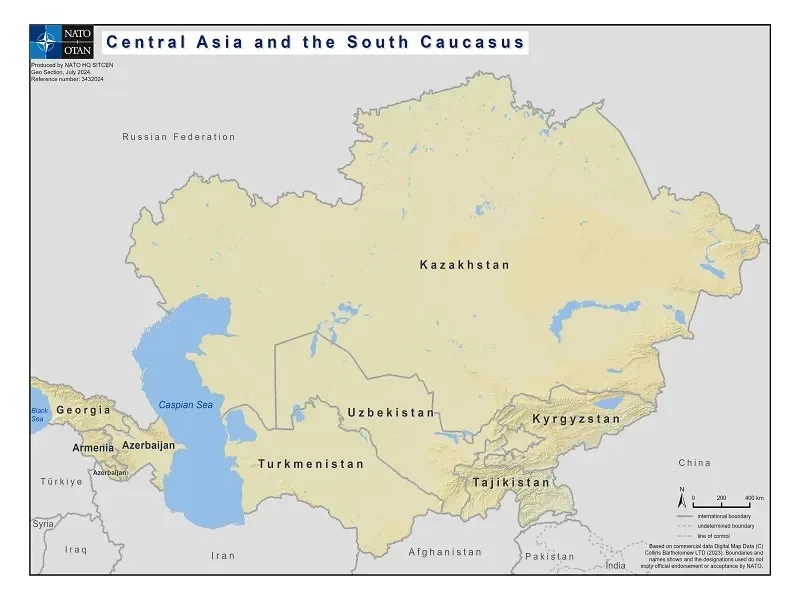
Russia’s leading security bodies—the Presidential Administration, Ministry of Defense, and Ministry of Foreign Affairs—have jointly acknowledged increasing threats originating from NATO’s expanding influence in the southern regions bordering Russia. This new consensus follows a period of strategic recalibration that reflects Moscow’s concern over military and political shifts in the South Caucasus and Central Asia.
Central to this heightened alert is the recent emergence of what Russian officials refer to as the “Trump Route for International Peace and Prosperity” (TRIPP), a multi-regional infrastructure and logistics initiative that unexpectedly shifted regional dynamics. Initially believed to be under Russian security oversight, the corridor connecting Armenia and Azerbaijan instead evolved into a vessel serving NATO’s logistical interests toward Central Asia. This change challenges Russia’s longstanding regional dominance and introduces the risk of a multi-front proxy confrontation.

Compounding Russia’s strategic unease is the move by both Armenia and Azerbaijan to deepen military ties with Western powers. The United Kingdom’s decision to lift its arms embargo on these countries, combined with Azerbaijan’s transition to NATO military standards and Kazakhstan's production of NATO-compatible munitions, signifies a broader encirclement effort. These developments, alongside Azerbaijan’s de facto military alliance with Ukraine and partnerships with Turkey, the US, and the UK, reveal a concerted push to bolster Western military presence near Russia’s southern borders.
The unified message from the Russian Triad came into sharper focus after a pivotal meeting between Russian officials and Armenian Prime Minister Nikol Pashinyan. Following this encounter, Deputy Prime Minister Alexei Overchuk highlighted for Russian media that TRIPP disrupted a regional balance that had been in place since the early 19th century. Shortly thereafter, Defense Minister Andrey Belousov informed the Shanghai Cooperation Organization that Russia monitors closely the growing military infrastructure efforts by non-regional actors seeking footholds in Central Asia.
These strategic recalculations reflect Moscow’s awareness of a resurging geopolitical contest in its near-abroad, wherein the integration of NATO military logistics, arms standardization, and diplomatic alignments build toward a potentially volatile three-front pressure—Eastern Europe, the South Caucasus, and Central Asia. Russia’s response indicates an effort to preempt threats that could arise from this multi-dimensional encirclement strategy.