

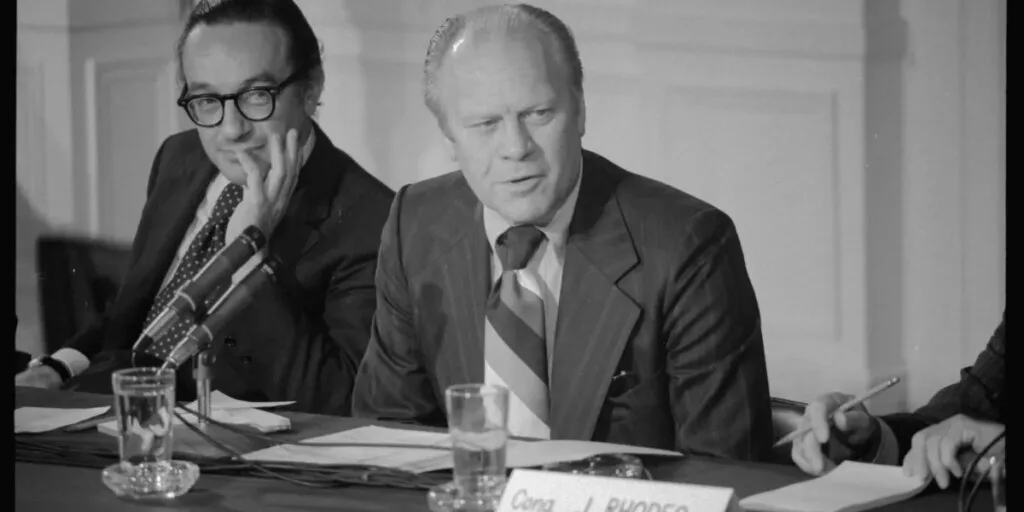
Alan Greenspan, who died recently at the age of 100, is widely recognized for his long and impactful leadership as chairman of the Federal Reserve. However, his formative experience directing economic policy during President Gerald Ford’s administration played a crucial role in defining his approach to public service and economic management.
Greenspan served as chair of the Council of Economic Advisers from 1974 to 1977. This period, although overshadowed by his subsequent near two-decade tenure at the Fed, was pivotal in shaping his practical, data-driven philosophy toward economics and policy. Those who knew Greenspan personally recall how committed he was to applying empirical data over ideology in forecasting and decision-making, emphasizing the importance of understanding economic structures and real-world information to anticipate future trends.

Before entering public service, Greenspan’s path was unconventional. He trained as a professional clarinet player at the Juilliard School while studying at New York University, later shifting focus entirely toward economics. His early intellectual influences included his association with the libertarian thinker Ayn Rand and her circle, which championed individualism and laissez-faire principles. Despite criticism for this association, Greenspan’s own economic outlook evolved into one rooted largely in pragmatic analysis rather than rigid ideology.
Greenspan pursued graduate studies at Columbia University before leaving academia to found a consulting firm. There, he honed his skills as an economic forecaster, gaining expertise across numerous industries and developing analytical methods that earned acknowledgment from leading figures in economics. For example, he anticipated concepts later recognized by Nobel laureate James Tobin in investment theory.
The preparatory years of data-driven forecasting, consulting expertise, and early public service during the Ford administration laid the foundation for Greenspan’s later influence on U.S. monetary policy. His tenure at the Council of Economic Advisers immersed him in the practical challenges of economic governance at a volatile time for the American economy, a period that helped forge his reputation as a cautious yet insightful steward of economic stability.