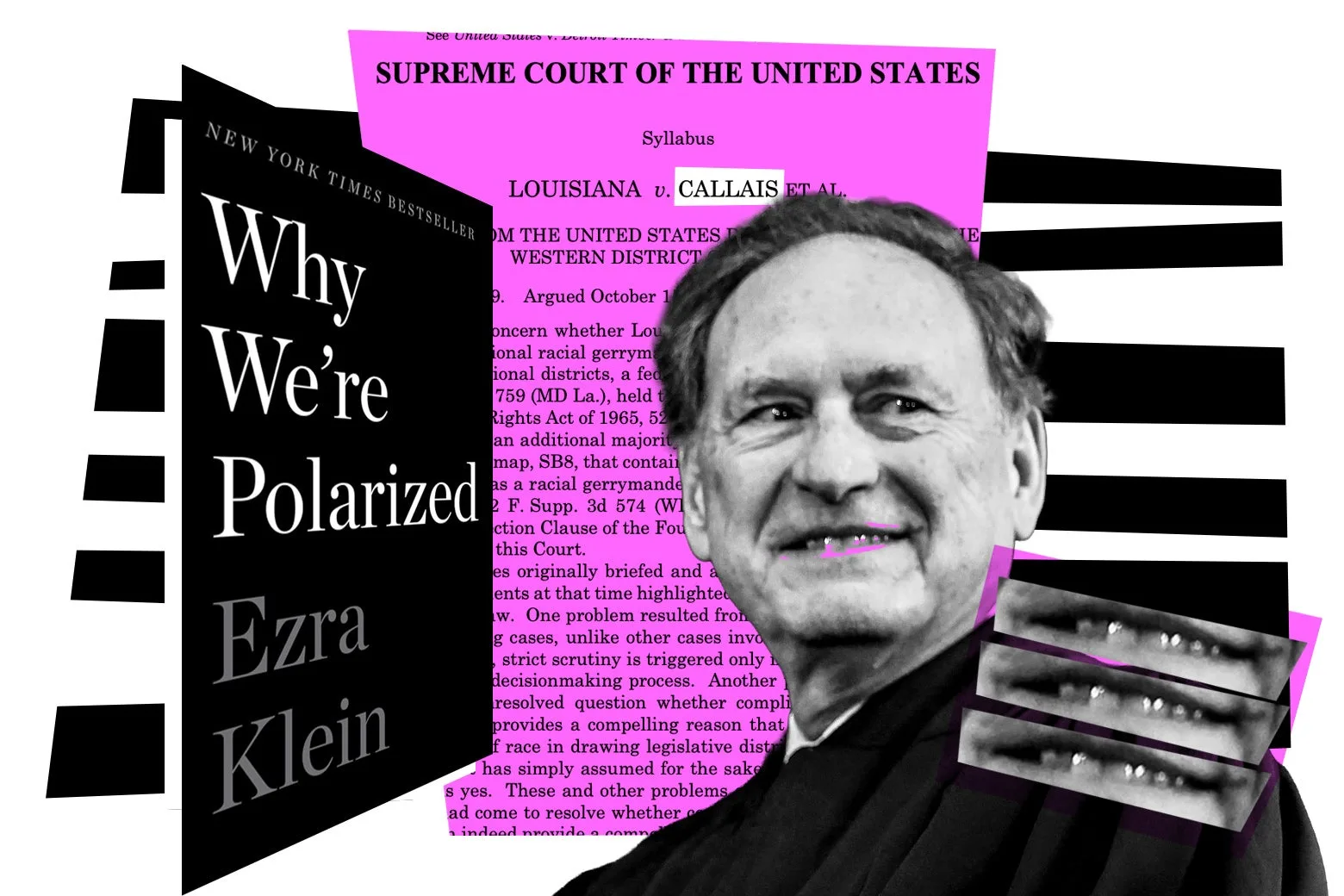
The Supreme Court's decision in Louisiana v. Callais has reignited debate over how American political elites have framed—and potentially misframed—the nation's deepest problems. In the ruling, the court's conservative majority held that when a legislative district is polarized along party lines, it cannot simultaneously be found polarized along racial lines under the Voting Rights Act. The practical effect is stark: in a country where over 90 percent of Black voters support Democrats and over 70 percent of White voters support Republicans, any racially discriminatory map can now be recharacterized as purely partisan.
For the past two decades, major American institutions built their analysis around a particular diagnosis: that partisan polarization—not racism or authoritarianism—was the root pathology threatening democracy. Universities including Duke and Princeton launched dedicated research initiatives on polarization. The organization No Labels raised tens of millions of dollars. Carnegie Foundation fellowships and commissions from the American Academy of Arts and Sciences centered on "bridging divides" between parties. Ezra Klein's bestselling book asked not why democracy was dying, but "Why We're Polarized." This intellectual architecture, critics contend, inadvertently provided conceptual tools for the Callais decision.

The court's reasoning contains what observers describe as a fundamental statistical error. The majority treats race and party as competing explanations, assuming that controlling for one neutralizes the other. But for millions of American voters, race directly explains party affiliation. Black voters did not randomly sort into the Democratic Party; they were drawn there progressively through Barry Goldwater's opposition to the Civil Rights Act and subsequent Republican Southern Strategy campaigns. To "control for partisanship" when assessing racial gerrymandering, the argument goes, is to erase the mechanism through which racism operates.
The analogy offered is of a company claiming it paid men and women equally once you account for management positions—roles from which women were systematically excluded. Or a diet study concluding sodium has no effect on stroke risk once you exclude people with high blood pressure.
Historical context further complicates the polarization narrative. American politics has almost always been organized by party. The exceptional era was the mid-20th century New Deal coalition, when segregationists and civil rights advocates coexisted in the Democratic Party only by keeping racial issues off the agenda. To conclude that partisan divisions now negate racial ones would require assuming the Civil War itself had nothing to do with race.
While polarization advocates did not directly author the Callais ruling, the argument suggests they created the intellectual conditions for it. Decades of elite discourse treating partisan division as the master problem delegitimized race-centered arguments as divisive. That cultural shift handed the court majority a respectable framework for what would otherwise appear as nakedly discriminatory reasoning. The Voting Rights Act's protections against racial vote dilution have effectively been nullified through vocabulary borrowed from the depolarization movement.