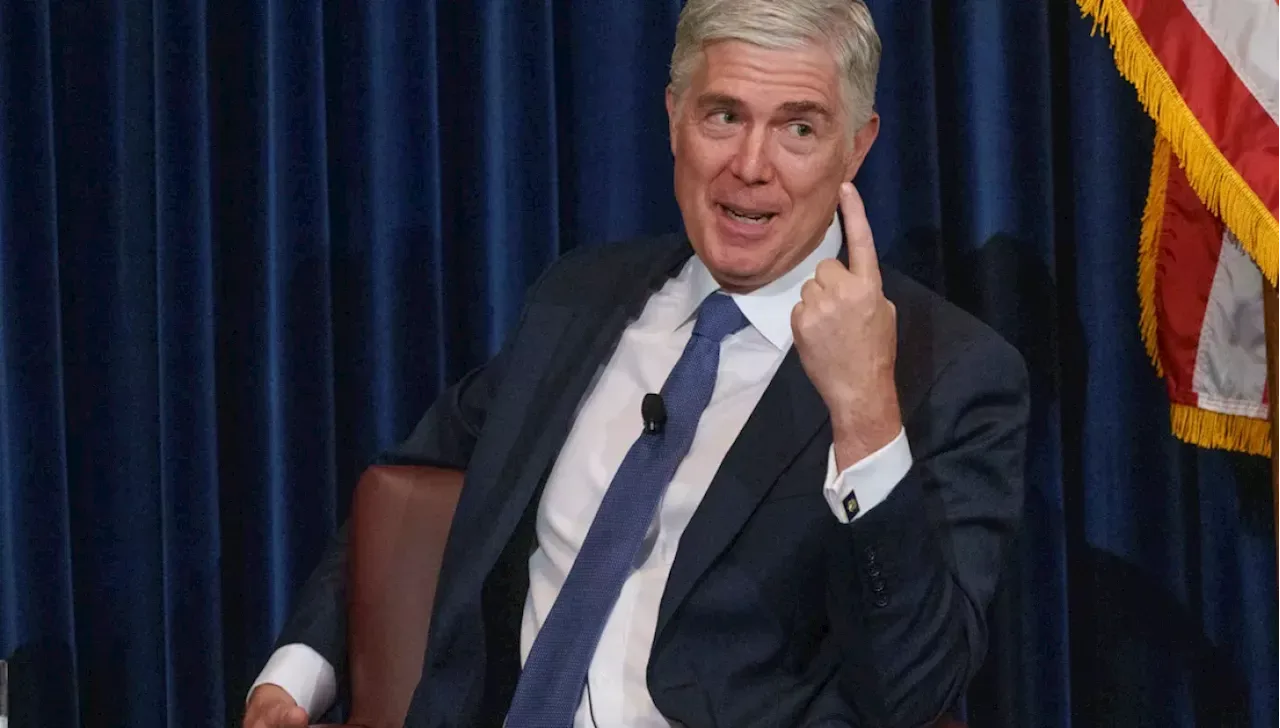
Supreme Court Justice Neil Gorsuch said Sunday that justices need to balance public transparency with the ability to engage in candid private discussions, remarks that come amid recent disclosures of internal court materials. Speaking to a network, Gorsuch acknowledged the value of live audio from the courtroom, which allows the public to listen to oral arguments, but emphasized that justices require time to communicate privately to reach agreement on cases.
"But do we need time to actually talk quietly with one another, to find those places where we can reach agreement? Yeah, we do. And that's nothing new," Gorsuch said. He framed these private exchanges as essential to the judicial process, distinguishing between the deliberation phase and the final public record that emerges through written opinions.

Gorsuch pointed out that all of his reasoning on cases is contained in written opinions available for public scrutiny. "Everything that I think about a case is there, on the printed page for anybody to read, if they so choose," he said, suggesting that transparency ultimately prevails through official judicial output.
His comments arrived as the court has faced recent leaks of internal documents. In one instance, 16 pages of internal court memos regarding the origins of the court's "shadow docket" strategy were disclosed to media outlets. Those memos stemmed from the court's 2016 decision to halt a climate plan from the Obama administration pending judicial review.
Some court observers have expressed concern that the leaks signal increasing political pressure on an institution designed to operate independently of partisan influence. However, Gorsuch voiced confidence in the court's functioning. He noted that justices have been appointed by five different presidents over 30 years, yet the court resolves cases unanimously about 40 percent of the time.
"So when you bear that in mind, I'd say the system's working pretty much as it has for a very, very long time," Gorsuch said. He also expressed personal regard for his colleagues, including those appointed by Democratic presidents, describing his disagreements with justices across ideological lines with warmth.
"I don't expect to persuade my colleagues in every case. I know we're going to disagree. I'm an originalist. And Justice Breyer or Justice Sotomayor, they're not originalists. I love them, and we have a good time together disagreeing," Gorsuch said.