

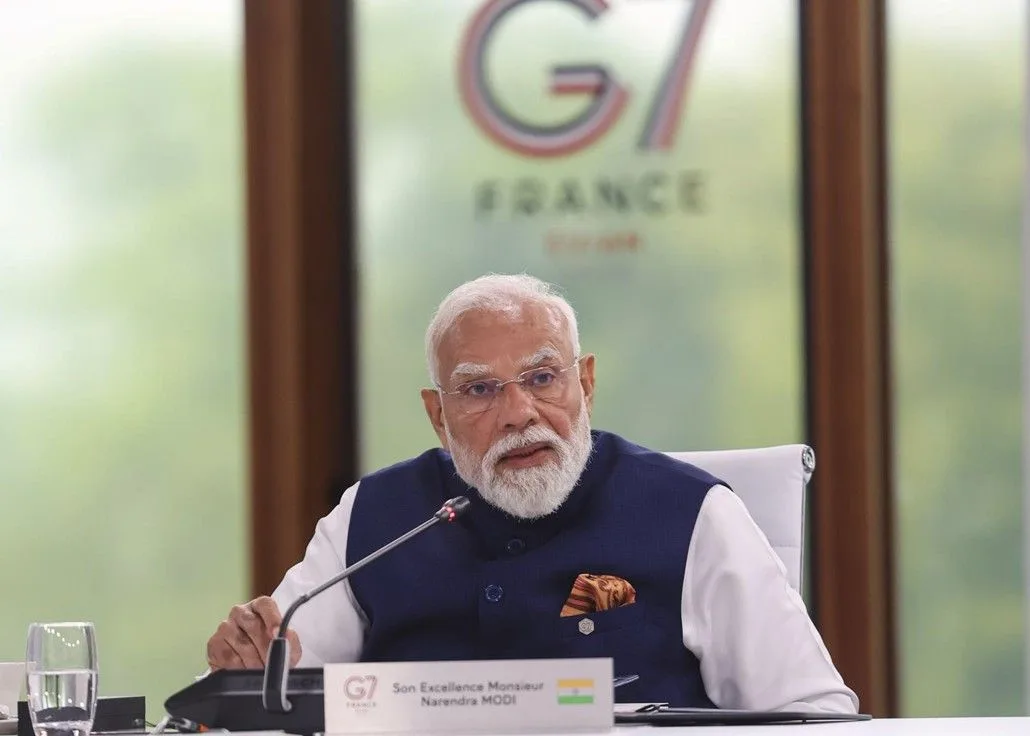
Prime Minister Narendra Modi emphasized the importance of a human-centric approach to artificial intelligence during his address at the G7 Summit session on the safe and efficient deployment of AI technologies. He highlighted that the true value of AI lies not in machine power but in how it empowers ordinary people across various sectors.
Modi outlined India’s guiding principles for AI development, known as the MANAV Vision, which focuses on ethical systems, accountable governance, national sovereignty, inclusivity, and legitimacy. He linked this framework to a recent communication from Pope Leo XIV, stressing that human values and meaningful human control should remain central to AI advancements worldwide.

The Prime Minister pointed to AI’s transformational impact on fields such as healthcare, education, manufacturing, and governance, noting how it accelerates scientific research and enhances government responsiveness. However, Modi warned of the risks AI poses to child safety, citing potential exposure to misinformation, deepfakes, and exploitation if proper safeguards are not established. He called for digital environments to foster learning, creativity, and personalized education while protecting children from manipulation.
Modi further addressed cybersecurity challenges linked to AI, stating that no nation can achieve full digital security unless all countries collaborate on secure cyberspace. He reaffirmed India’s stance that cyberspace should be treated as a global public good and advocated for all democratic nations to have access to advanced AI technologies to protect vital infrastructure and counter emerging cyber threats.
To advance the responsible rollout of AI, Modi proposed several key measures: making safety a core element of AI system design; establishing common standards, testing procedures, and regulatory sandboxes to balance innovation with oversight; and fostering international cooperation to ensure AI benefits are broadly shared and risks managed collectively.