

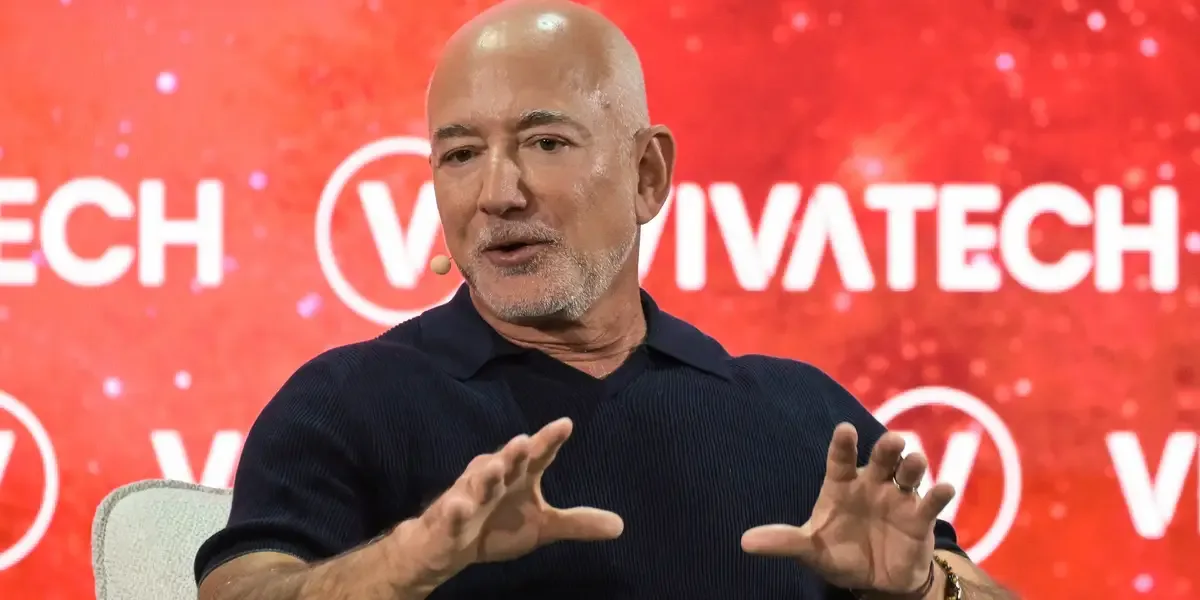
Jeff Bezos rejected the common narrative that artificial intelligence will trigger mass unemployment. Speaking at the VivaTech conference in Paris, the Amazon founder asserted that AI’s true impact will be to create a labor shortage by increasing the need for people who can turn ideas into real-world products and businesses.
Highlighting the vast potential for innovation, Bezos said that imagination is abundant, but the limitation lies in the ability to execute ideas. He argued that AI will speed up this process, allowing more concepts to move beyond mere thoughts to actual inventions and enterprises, thereby expanding job opportunities rather than reducing them.

While many economists and workers express concern that AI-driven automation could replace human labor across multiple sectors, Bezos framed the technology as an enabler that will fuel a demand for builders, creators, and entrepreneurs. According to him, many people hold ideas that never materialize due to complexity and feasibility barriers—AI could remove those hurdles and accelerate development cycles.
Bezos illustrated this vision by discussing AI’s potential role in space exploration. He envisions a future where reliable and affordable space travel allows heavy industries to move off Earth, sourcing materials from asteroids and the moon. This shift could help restore Earth's environment to a state akin to before the Industrial Revolution.
This outlook aligns with other tech leaders imagining humanity’s expansion beyond Earth. For example, Elon Musk has described future lunar and Martian colonies supported by AI data centers in space, with routine space tourism becoming feasible.