

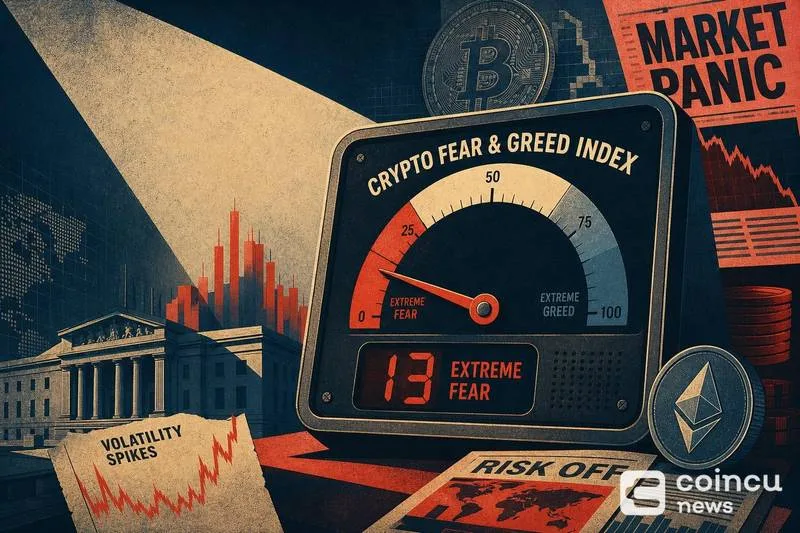
The Crypto Fear & Greed Index recently dropped to 13, situating market sentiment firmly within the “extreme fear” category and reflecting growing panic among cryptocurrency traders and investors. This index gauges overall mood in crypto markets using a scale from 0 to 100, where values below 25 show severe fear and those above 75 indicate greed. A score as low as 13 suggests that investors are exhibiting heightened caution and aversion to risk.
The index compiles multiple data points daily, including price volatility, trading momentum and volume, social media trends, Bitcoin dominance, and global search interest. The simultaneous negative signals across these areas contribute to the sharply lower score, indicating coordinated downturns rather than an isolated factor influencing the panic.

Although the index quantifies current emotional climate, it does not serve as a direct predictor of future price movements. Extreme fear readings often coincide with steep Bitcoin price declines or periods of heightened volatility, yet low scores alone do not guarantee a market bottom. Investors acting solely on this metric risk premature entries during ongoing downturns.
Bitcoin’s influence dominates the index, as its price action heavily impacts overall crypto sentiment. Because Bitcoin’s market share and correlation with altcoins weigh into the calculation, a rapid BTC selloff tends to amplify fear across all digital assets. This process can trigger forced liquidations of leveraged positions on exchanges, accelerating price drops and deepening negative sentiment.
Altcoins frequently suffer sharper losses than Bitcoin during selloffs, intensifying panic especially among retail traders exposed to smaller tokens. Elevated open interest in perpetual futures contracts can lead to cascading liquidations in highly leveraged environments, further magnifying market stress and driving the index into very low readings like the current 13.
The convergence of these factors—Bitcoin’s price decline, leveraged liquidations, and altcoin selloffs—fuels the feedback loop that pushes sentiment toward the extreme fear threshold. Historically, such low readings have attracted attention both from traders seeking potential reversal points and from institutions monitoring broader risk levels, though interpreting the index requires caution given its focus on present emotional states rather than fundamental valuation.