

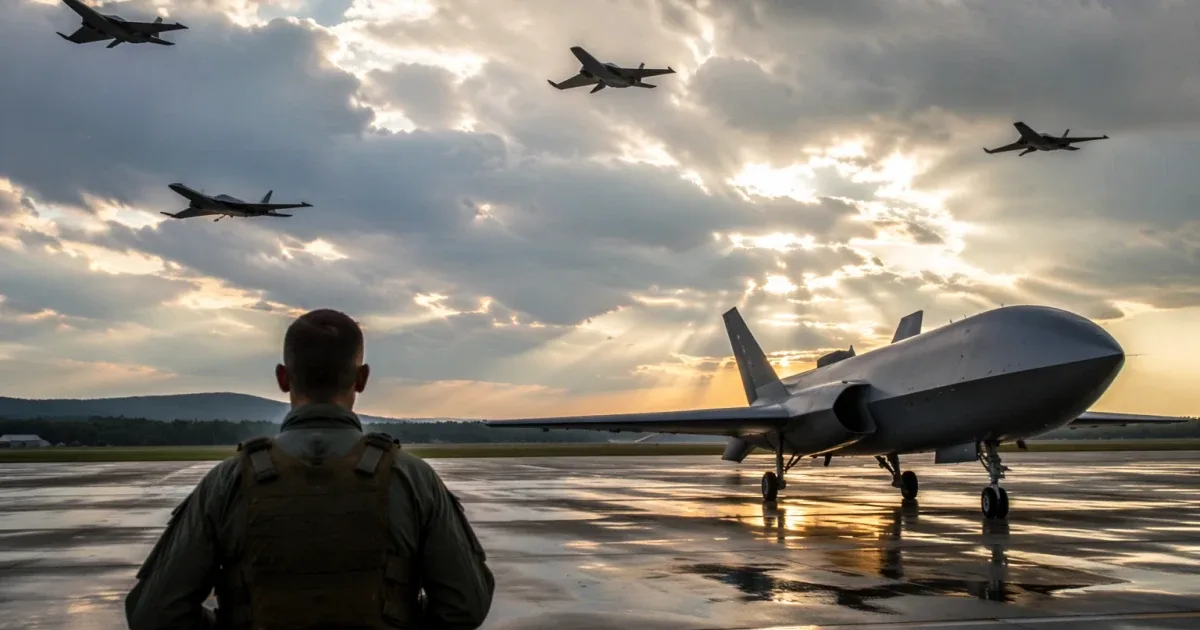
European militaries are rapidly advancing AI-assisted wingman drones, reflecting a transformation in aerial warfare where unmanned systems enhance manned aircraft capabilities. The recent ILA Berlin airshow highlighted this shift by featuring drones designed to fly alongside fighter jets, augmenting missions with sensors, electronic warfare tools, and weapons while providing pilots with critical data without replacing them.
This new generation of wingman drones acts as a force multiplier, extending reach and absorbing operational risks previously borne solely by manned platforms. The ongoing conflict in Ukraine has demonstrated the strategic value of drones and electronic warfare, accelerating investments in systems that prioritize cost-efficiency, modular upgrades, and software-driven adaptability over exclusively crewed fighters. This approach aligns with military commanders’ demand for scalable, flexible airpower.

Boeing’s MQ-28 Ghost Bat program exemplifies these developments. Having completed over 150 flights, the unmanned jet is positioned as a companion to manned aircraft, featuring an open and modular design that supports continuous hardware and software innovation. Boeing has expanded its German industrial partnerships to include firms specializing in weapons integration and communications technology, emphasizing collaborative development within Europe.
Airbus reinforced this trend by unveiling its U760 Ravenstorm loyal-wingman drone at the airshow, demonstrating Europe’s commitment to embedding such systems into core air combat doctrine rather than viewing them as experimental additions. Meanwhile, General Atomics resumed flight tests with its YFQ-42A fighter-escort drone following upgrades prompted by earlier incidents and safety reviews.
Technology firms like Helsing contribute to the ecosystem by providing AI frameworks that empower future combat air systems. Their operational AI platform is already in use by numerous pilots across multiple organizations, underscoring the practical application of AI autonomy. However, the question of technological sovereignty—particularly the control and deployment of AI decision-making in military contexts—remains an open debate among European nations.
While Germany and France have paused their joint fighter development over sovereignty concerns, the broader European defense community is clearly embracing AI wingmen as essential to future air operations. These drones are not intended to replace pilots but to operate as collaborative teammates, enhancing situational awareness, survivability, and mission effectiveness.