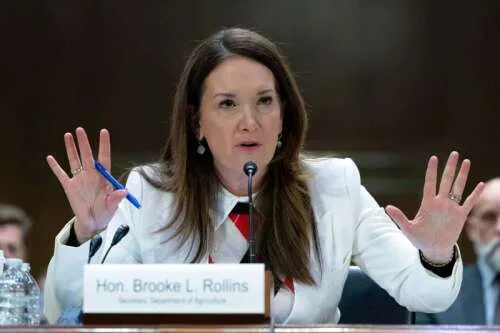
Agriculture Secretary Brooke Rollins attributed the departure of 4.3 million people from the Supplemental Nutrition Assistance Program (SNAP) to fraud reduction, ineligible recipients leaving the rolls, and economic improvement. But academic researchers studying food insecurity say new federal legislation is the primary cause of the sharp decline.
The drop occurred as H.R. 1, the "One Big Beautiful Bill Act," reshaped eligibility requirements and work obligations. The law is projected to cut $186 billion in federal SNAP spending over 10 years, according to the Congressional Budget Office. The steepest declines came after President Trump signed the bill in July 2025, with approximately 3.47 million people leaving the program between July and January, compared to just 743,572 from January to June.

Rollins claimed fraud drove much of the exodus. Data contradicts this. In fiscal year 2023, only 41,476 people were disqualified from SNAP for fraud—less than 1 percent of the 42.1 million total participants. Caitlin Caspi, an associate professor at the University of Connecticut studying food insecurity, stated: "I don't see any evidence supporting a significant reduction in fraud as a driver of what we're seeing as far as declining SNAP participation." When asked for evidence, the USDA did not provide data directly supporting the fraud claim.
The legislation imposed stricter work requirements. Previously, able-bodied adults without dependents over age 54 were exempt from enhanced work requirements; the bill raised that age to 64. The minimum work obligation—80 hours per month—remained, but fewer people now qualify for exemptions. Homeless individuals, veterans, and former foster children under 25 lost exemptions entirely. Additionally, the bill lowered the age of dependent children triggering exemptions from 18 to 14. Refugees and asylees, previously eligible, now cannot receive benefits.
Rollins also credited economic growth. While wage growth at 3.4 percent did outpace inflation at 3.3 percent in March 2026, the secretary's claim that this was "the first time since early 2021" was inaccurate. More significantly, food prices rose 3.1 percent in 2025 and are projected to climb 2.9 percent in 2026. Unemployment ticked upward, and wage gains disproportionately benefited higher-income households rather than lower-income workers who rely on SNAP.
Kate Bauer, an associate professor of nutritional sciences at the University of Michigan, noted the structural challenge: "We have a persistent poverty problem in this country and we have huge economic disparities. And most people, even in good economic times, are not able to pull their families out of poverty."
SNAP participation stood at approximately 42.83 million in January 2025, declining nearly 10 percent to about 38.55 million by January 2026. The Congressional Budget Office predicted in August 2025 that the legislation would reduce participation by roughly 2.4 million people monthly across the 2025-2034 period.