

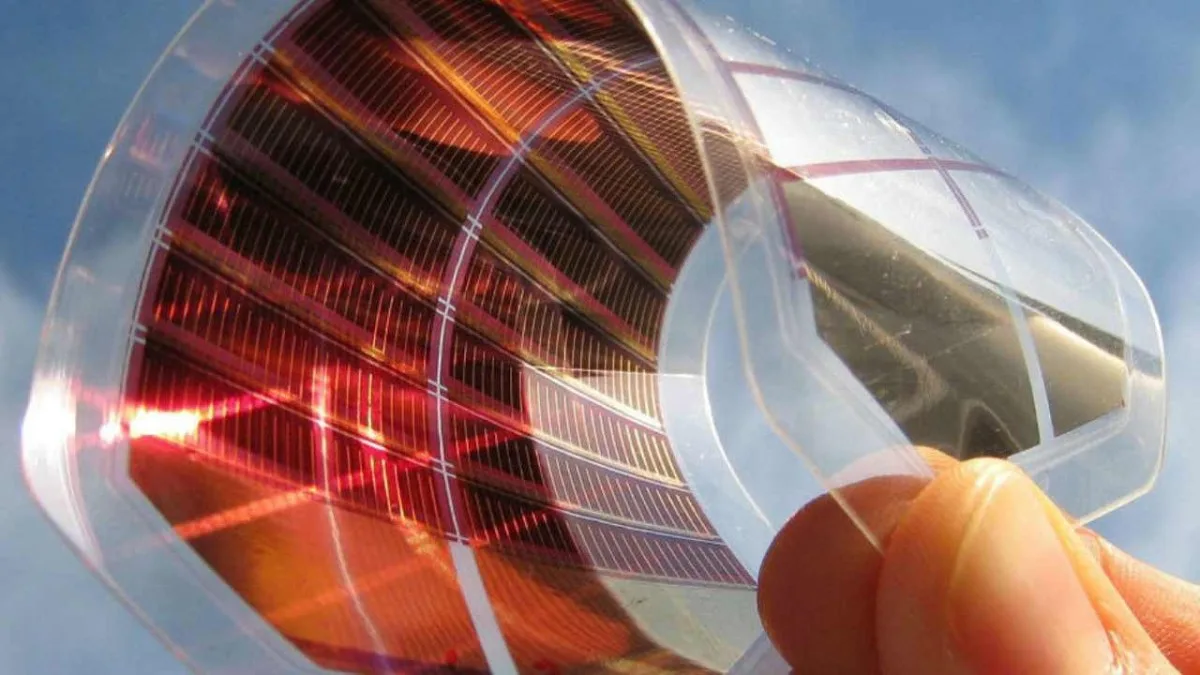
China has reclaimed its position as a leader in solar technology after Trina Solar unveiled a record-breaking solar panel that delivers 29.2% conversion efficiency and 907 watts of power output. This milestone was reached using cutting-edge perovskite-on-silicon tandem technology, which layers two solar materials to maximize sunlight absorption and electricity generation beyond conventional limits.
The tandem design places a perovskite layer on top of a silicon base, allowing the panel to capture a wider spectrum of sunlight. The perovskite absorbs higher-energy wavelengths while the silicon layer harvests light that passes through, enhancing overall efficiency. Trina Solar also introduced an innovative interconnection between these layers to minimize energy losses and boost electrical current flow.

This achievement surpasses the previous record of 28.6% efficiency set by South Korea’s Qcells, a notable advancement that demonstrated the potential for mass-produced high-efficiency panels. Both Trina and Qcells conducted their breakthroughs on industry-standard 210 mm wafers rather than small lab samples, underscoring readiness for commercial manufacturing.
With its new panel, Trina Solar boosted power output from its earlier record of 808 watts to 907 watts. The company also reported an even higher efficiency of 32.6% on half-cut cells, confirming the scalability of this technology for large-scale solar projects. This progress reinforces perovskite solar cells as a promising alternative to traditional silicon panels, which typically operate at 21% to 23% efficiency.
Despite the push forward, the solar industry still faces challenges in proving the long-term durability of perovskite-based cells and scaling their production to meet global demand. However, Trina Solar’s milestone marks a significant step toward lowering costs and increasing the power density of commercial solar modules, potentially transforming how solar energy is deployed worldwide.