

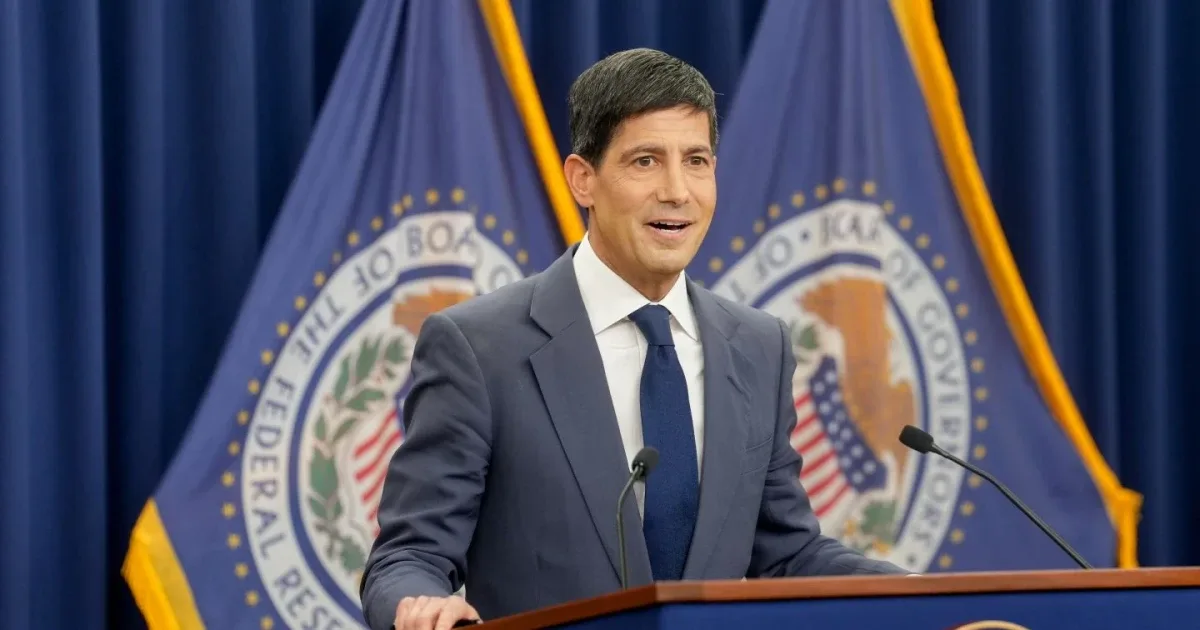
In a significant shift at the Federal Reserve, Kevin Warsh removed forward guidance from the central bank’s communication, signaling that markets should play a greater role in determining policy expectations. This move came alongside the Fed’s decision to hold interest rates steady but recalibrated how investors interpret future rate moves.
The Federal Open Market Committee maintained the benchmark rate at a range between 3.5% and 3.75%, but Warsh’s decision to strip down the Summary of Economic Projections and avoid offering personal forecasts marked a strategic pivot. By eliminating the usual language about anticipated rate cuts, the Fed deferred the task of predicting its path to the markets themselves. This change coincided with the announcement of five new task forces focused on enhancing areas such as communication strategy, the balance sheet, and inflation frameworks, reflecting Warsh’s broader agenda for institutional reform.

Market reactions were swift and pronounced. The yield on the policy-sensitive 2-year Treasury note rose sharply, while the dollar surged to its highest level in a year, surpassing 100.80 on the dollar index. Major currencies weakened as traders increased the likelihood of a rate hike later this year, betting heavily on a September or October move. These developments highlight the tangible impact of Warsh’s approach on financial conditions, influencing mortgage rates, consumer loans, and global trade dynamics.
By stepping back from explicit Fed signaling, Warsh aims to let market forces reveal the most appropriate policy path, accepting increased short-term volatility as a necessary trade-off. This strategy contrasts with recent Fed practice, which often sought to smooth market reactions through clear communication. The shift suggests a new era in central bank policy where uncertainty around rate forecasts may become the norm, prompting investors to adjust more rapidly to economic data and evolving financial conditions.