

Global sports has completed its transformation from entertainment business to institutional asset class. The industry now generates more than $500 billion in annual revenue by most sector estimates, and the capital flowing into it increasingly comes from the same players that dominate private markets: buyout funds, sovereign wealth vehicles and big tech platforms.
From trophy assets to portfolio strategy
What was once the domain of billionaire owner-patrons is now a structured investment thesis. CVC Capital Partners committed roughly €2 billion to Spain's LaLiga, US private equity firms have taken stakes across European football, and the NFL — long the most restrictive major league — opened its franchises to private equity ownership. Multi-club structures such as City Football Group and Red Bull operate portfolios of teams across continents, managed less like clubs and more like holding companies. Franchise valuations, meanwhile, keep setting records with every transaction.

Media rights and stadiums drive the revenue stack
The distribution side is consolidating around technology companies. Amazon, Apple and Netflix have all acquired premium live sports rights, bidding directly against legacy broadcasters and pushing the value of media rights to new highs. At the same time, stadiums are being repositioned as year-round real estate assets, generating income from concerts, corporate events and naming-rights deals rather than matchdays alone.
Latin America: the next frontier
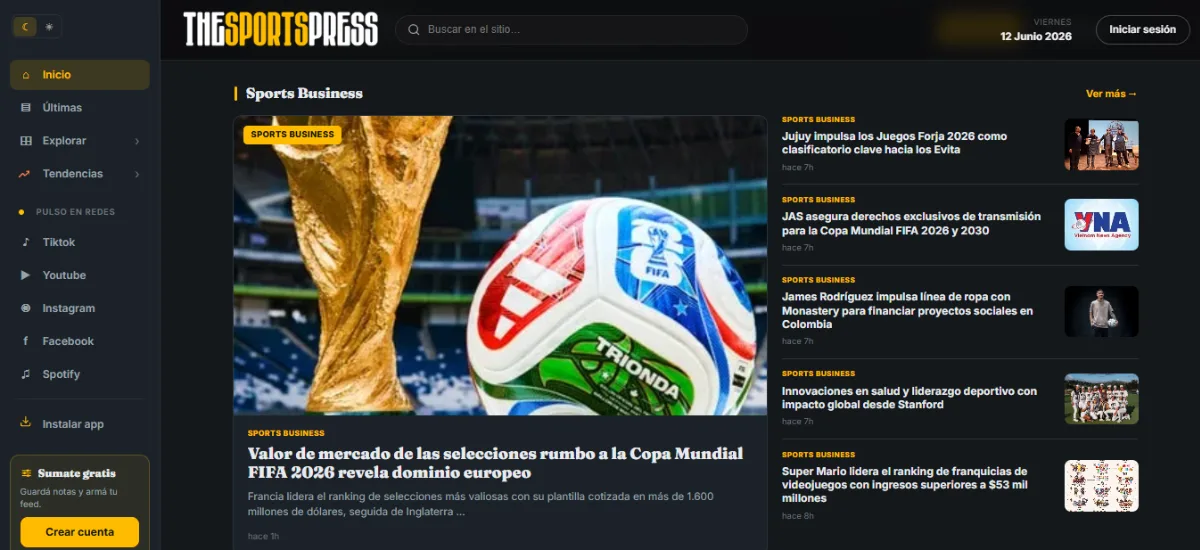
Much of the industry's untapped growth sits in emerging markets, and Latin America in particular — a region that exports playing talent at scale but has historically lagged in commercial sophistication. The information ecosystem is catching up: The Sports Press, a new Spanish-language outlet dedicated to the business of sports, now covers sponsorship, broadcast rights, stadium financing and the transfer market daily for that audience — a signal that the sector's professionalization is reaching markets where sport has long been culture first and industry second.
With the 2026 World Cup — the most commercially ambitious edition in history — currently underway across the United States, Mexico and Canada, the asset class has never had a louder showcase.