

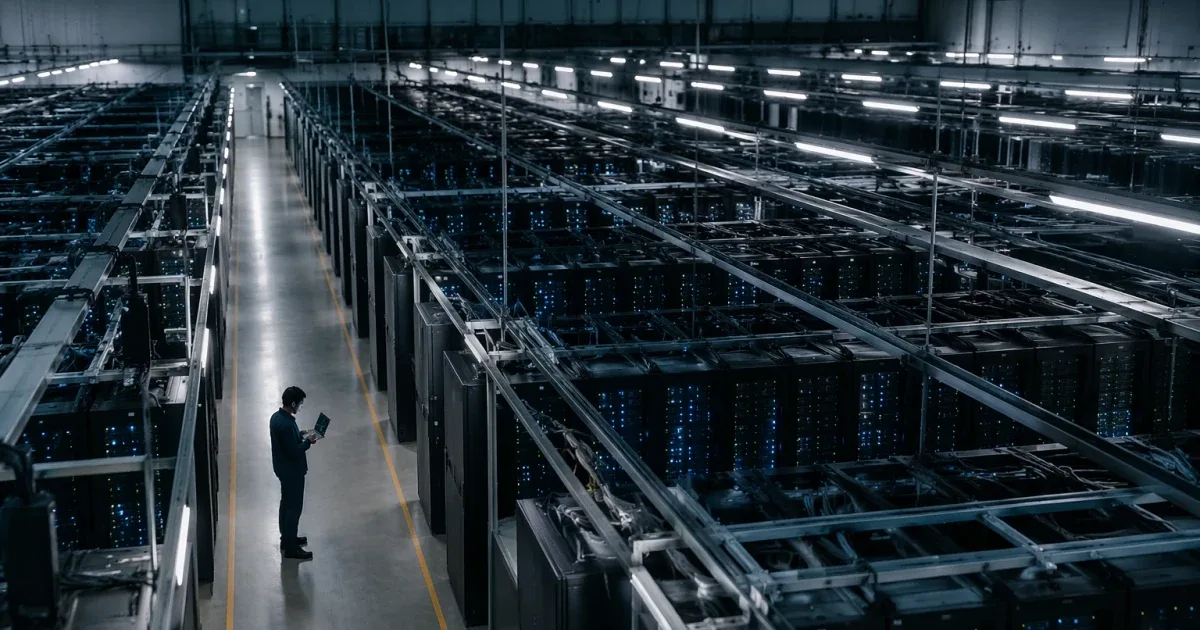
China is embarking on a massive investment in data center infrastructure, allocating close to 2 trillion yuan ($295 billion) over the next five years to strengthen its artificial intelligence capabilities. This initiative treats computing power as a crucial strategic asset, alongside semiconductor production and energy, signaling the government’s push to close the technological gap with the United States.
The plan involves key state agencies, including the National Development and Reform Commission, which demand that at least 80% of the hardware — such as AI chips — come from domestic manufacturers. This requirement targets reducing dependence on foreign suppliers like Nvidia and AMD, while fostering a fully localized AI technology ecosystem. The effort supports a broader ambition to integrate AI into 90% of China’s economy by 2030, a core element in the country’s 15th Five-Year Plan and the AI Plus initiative.

Despite the sweeping vision, policymakers face a significant hurdle from an existing surplus of data-center capacity following a recent construction surge. Current utilization rates in some locations hover between 20% and 30%, leading to the cancellation of over 100 state-backed projects in the last year and a half. To address this, the Ministry of Industry and Information Technology is collaborating with major telecom operators—China Mobile, China Unicom, and China Telecom—on launching a state-run national cloud service designed to optimize excess computing resources.
Power supply presents a critical challenge as well. The International Energy Agency forecasts that electricity consumption by data centers will more than double globally by 2030, intensifying competition for land, network infrastructure, cooling capacity, and grid resources within China. This demand will coincide with efforts to rapidly expand domestic manufacturing and deployment of AI technologies amid increasing U.S. export restrictions on advanced AI chips, which have tightened controls on shipments to Chinese companies and their overseas subsidiaries.
If Beijing can sustain this extensive funding while managing previous overcapacity mistakes, the data center expansion could mark one of the most significant government-driven campaigns to reduce the compute superiority of American competitors, positioning China as a major player in the global AI race.