

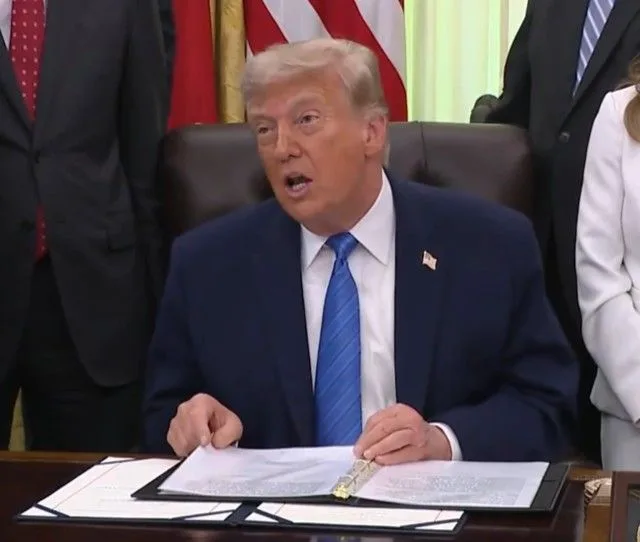
President Donald Trump raised uncertainty about the future of the United States-Mexico-Canada Agreement (USMCA), stating he is unsure whether he will renew the pact during his current term. Speaking after signing the Secure America Act, Trump said the agreement’s key strength lies in its provision allowing a review and possible termination after six years.
Trump criticized the predecessor of the deal, the North American Free Trade Agreement (NAFTA), calling it a disastrous trade agreement for the U.S. He acknowledged that USMCA addressed many deficiencies of NAFTA but underscored the renewal clause as the most valuable element of the new agreement.

Highlighting the economic dynamics between the three countries, Trump claimed that the U.S. holds stronger negotiating power. He argued that the United States does not rely on Canada or Mexico for critical goods, while the two neighbors depend heavily on U.S. products. This imbalance, he said, should compel Canada and Mexico to offer better trade terms.
Concerns about ongoing trade deficits with both partners also featured prominently in Trump's remarks. He emphasized that the U.S. should strive for trade surpluses rather than deficits with Canada and Mexico.
The USMCA, which replaced NAFTA and entered into force in 2020, modernized trade rules concerning goods, services, intellectual property, labor standards, and digital commerce among the three North American nations. It includes a formal review mechanism set to occur years after implementation, distinguishing it from its predecessor and allowing member countries to reassess the pact’s terms and effectiveness.
Trump did not formally announce plans to initiate the agreement’s review or to withdraw but his statements have injected uncertainty for industries reliant on integrated supply chains across the region. The review clause offers an opportunity for renegotiation, reflecting the delicate balance of trade and diplomacy among the U.S., Canada, and Mexico.