

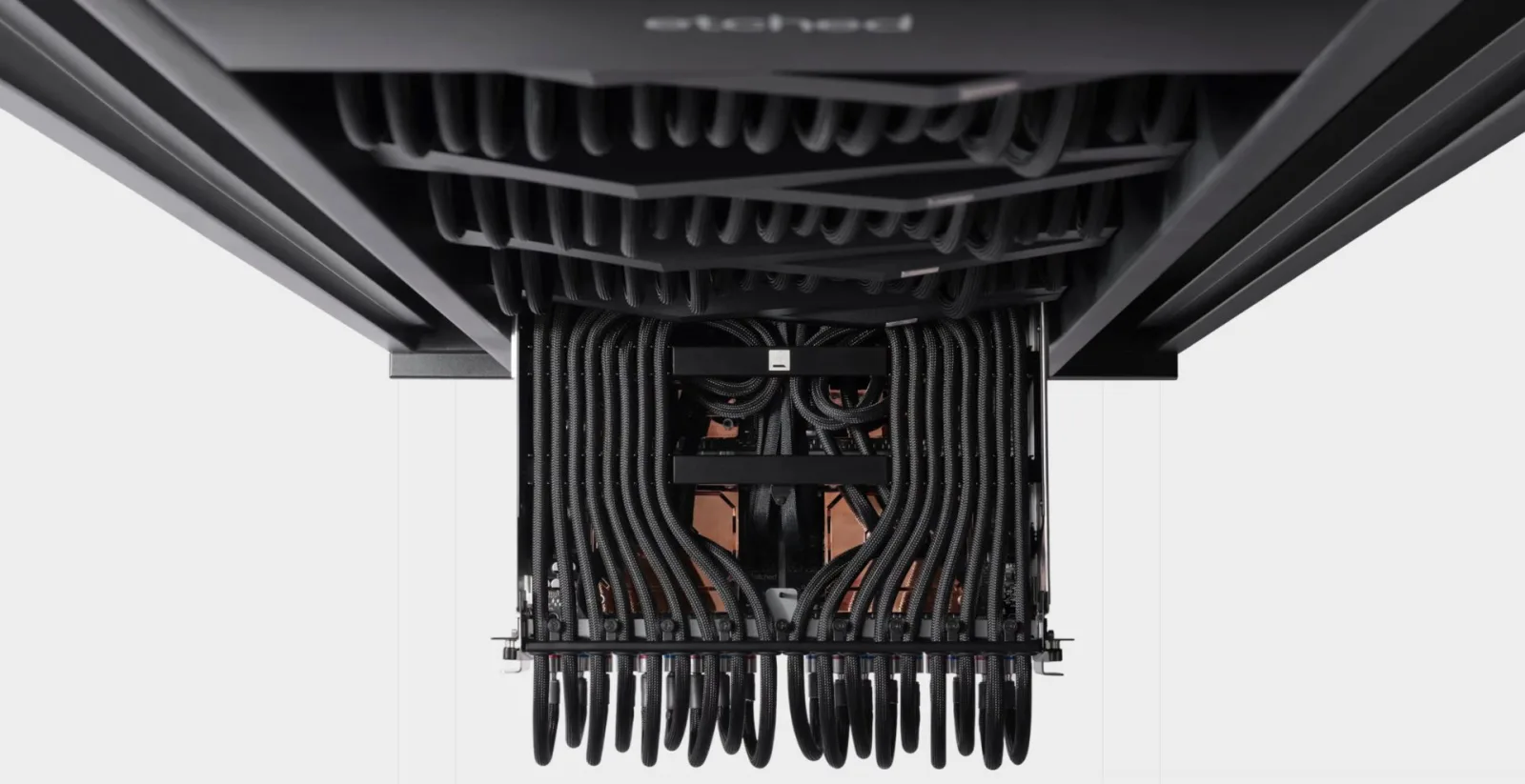
Etched, a recently launched artificial intelligence startup, revealed its first large-scale AI solution: the Frontier Inference Clusters. The company has drawn together more than 400 engineers with backgrounds at NVIDIA, Google, TSMC, Broadcom, and other semiconductor giants to build this advanced hardware and software ecosystem. Following a successful tapeout of its initial silicon chip, Etched reported customer demand exceeding one billion dollars, underscoring strong market interest in its technology.
The startup announced its first A0 silicon chip tapeout earlier this year, manufactured using TSMC’s cutting-edge N4P process. Since then, Etched has focused on integrating this chip into rack-scale products aimed at accelerating frontier AI models, including multi-trillion parameter mixture of experts (MoE) architectures and long-context agentic workloads. Early external tests demonstrate industry-leading throughput, latency, and power efficiency, with shipments of the first rack units scheduled for this summer.

Etched’s architecture features two core innovations tailored for next-generation AI inference. The first is a Low-Voltage Inference (LVI) processor designed to operate at roughly half the voltage of most existing AI chips while delivering 80% of peak floating-point operations per second (FLOPs). This approach addresses the common throttling problem in AI hardware, where chips reduce performance to manage power consumption when running at full voltage.
The second component, the Cluster Scale Memory (CSM), combines high-bandwidth memory (HBM) with large SRAM blocks to optimize low-latency tasks. Conventional SRAM offers fast decode speeds but suffers from limited memory capacity and FLOPs throughput, while HBM provides ample bandwidth but higher latency. Etched’s hybrid CSM approach balances these trade-offs, providing a shared memory pool that enhances reliability, reduces cost, improves thermal management, and maintains high performance.
To date, Etched has raised $800 million through multiple confidential funding rounds, including strategic investments from major venture partners. The company is actively expanding collaborations with leading semiconductor manufacturers to scale production and accelerate innovation in AI inference infrastructure. The Frontier Inference Clusters aim to deliver a full-stack solution supported by co-designed chips, racks, interconnects, and software, meeting the growing computational demands of sophisticated AI models.