

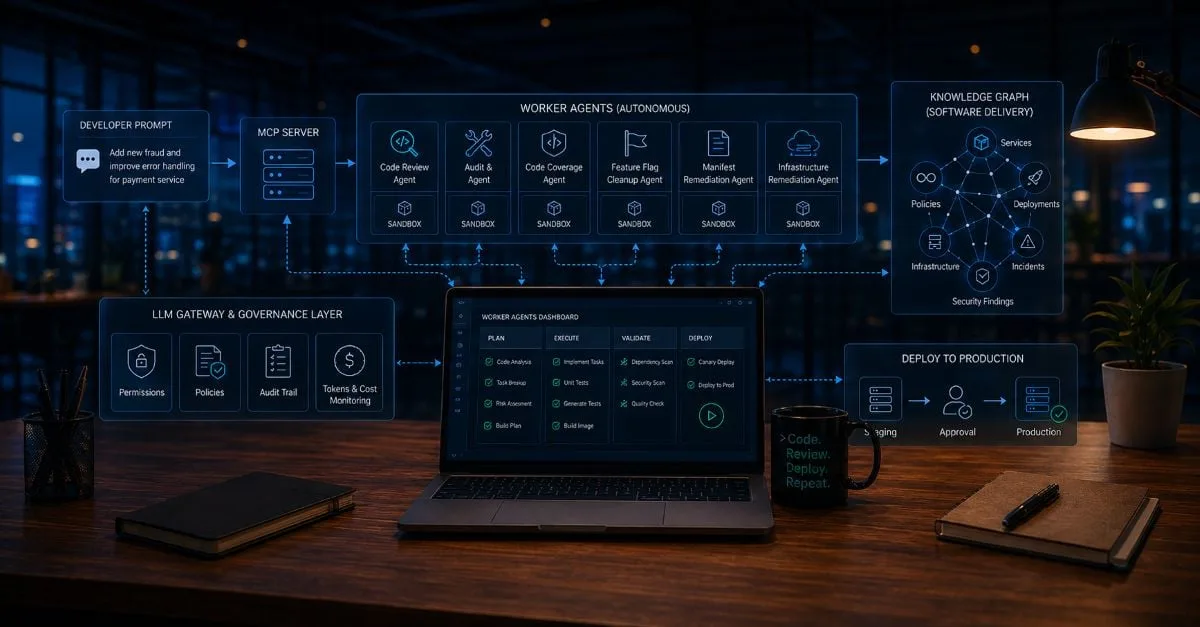
Harness has unveiled a new suite of autonomous AI agents that automate the delivery of code within DevOps workflows, reducing the reliance on fixed scripts and manual interventions. These AI-driven Worker Agents operate inside sandbox container environments and can be customized or used as provided by Harness to perform specific tasks within software pipelines.
The system leverages the Harness Model Context Protocol (MCP) Server, enabling AI coding tools to delegate tasks to these Worker Agents, which then execute them with precise permissions, maintaining strict operational boundaries regardless of the initiator or input instructions. Each agent accesses the Harness Software Delivery Knowledge Graph—a comprehensive map linking services, deployments, infrastructure, and security data—to contextualize workflows and execute tasks intelligently.

Designed to integrate with multiple AI model providers, these agents offer flexible model switching per agent, environment, or software pipeline without requiring code rewrites. Governance and compliance are reinforced through a centralized large language model (LLM) Gateway, which imposes uniform audit trails and policies comparable to those applied to human engineers, making this technology viable for regulated industries.
Harness also provides transparency in AI resource usage by tracking token consumption and expenses per agent and pipeline, allowing DevOps teams to manage costs efficiently. The company has launched a Harness Agent Marketplace featuring various AI agents ready for deployment, including:
- An Autofix agent that analyzes build logs to identify root causes of failures, applies fixes directly to pull request branches, and reruns builds until successful.
- A Code Review agent that assesses pull requests for code quality, security vulnerabilities, and test coverage adequacy.
- A Code Coverage agent that detects untested code sections and generates necessary tests to improve coverage.
- A Feature Flag Cleanup agent that identifies obsolete feature flags and verifies whether their removal is safe.
- A Manifest Remediator agent that diagnoses and corrects Kubernetes deployment manifest failures.
- An Infrastructure as Code (IaC) Remediation agent that resolves configuration drift, security issues, and cloud cost inefficiencies through automated configuration adjustments.
Additionally, every agent available in the marketplace can be forked, allowing DevOps teams to clone and modify existing agents by fine-tuning prompts, tools, or triggers to align with their specific environments. This approach aims to simplify coordination between AI agents across varied and complex software development lifecycle (SDLC) workflows.
According to Harness, the introduction of autonomous AI agents will transform the role of software engineers, who will increasingly operate as architects overseeing AI-driven processes rather than handling routine development tasks. This innovation underscores the growing impact of AI on DevOps efficiency, compliance, and scalability.