

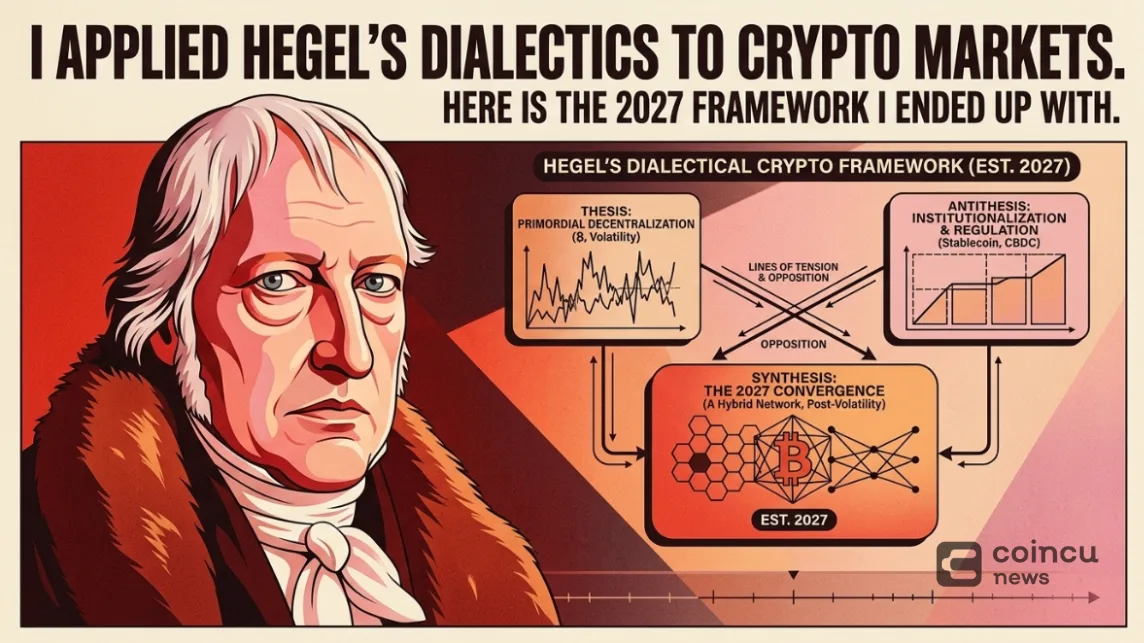
Crypto markets between 2024 and 2026 exhibited complex shifts that defied simple bull or bear storylines, prompting a novel approach to understanding their dynamics. Instead of focusing on price movements alone, examining structural tensions through the lens of Hegelian dialectics—a philosophical framework that explains change as a cycle of problems, corrections, and new contradictions—provides a clearer perspective on how crypto ecosystems evolve.
This approach highlights how existing market structures tend to collapse not due to external factors, but because their own strengths give rise to new weaknesses. These weaknesses provoke corrective responses that solve some issues but simultaneously generate others, sometimes ultimately leading to more resilient configurations. Unlike traditional economic or behavioral finance models, this dialectic perspective captures the layered complexity of crypto’s next developmental phase.

One striking example is the ongoing tension between centralized exchanges (CEX) and decentralized exchanges (DEX). CEXs excel in speed, liquidity, and user familiarity but centralize custody and trust. DEXs counter these drawbacks by enhancing security and decentralization but often sacrifice execution quality and liquidity consolidation. Emerging “Hyperliquid” platforms aim to reconcile this contradiction by combining on-chain order books with advanced execution layers and an integrated infrastructure that supports both trading and decentralized applications. While promising, this innovation does not fully resolve the core dilemma, suggesting further evolution is needed.
Bitcoin’s transformation also reflects shifting paradigms. As it becomes increasingly entwined with financial products and political discourse, the coherence of Bitcoin’s original thesis fractures, challenging previously dominant narratives focused solely on its function as digital money or store of value.
Ethereum’s scaling ambition illustrates another dialectic tension: while expanding capacity through various model adjustments, it suffers from fragmentation that complicates usage and development. This scalability-induced division reveals the limits of current technological remedies and hints at a continuous process of trial and adjustment.
Decentralized finance (DeFi) navigates a similar trajectory, moving away from simple inflation-driven yield incentives toward more sustainable, revenue-based models. This shift embodies a corrective reaction that addresses some earlier excesses but introduces new structural complexities within incentives and capital flows.
The role of memecoins also fits this dialectical model. Once fringe and decentralized, they are transitioning toward varying degrees of institutionalization, reflecting how social phenomena within crypto markets respond to cycles of hype, skepticism, and normalization.
Stablecoins, crucial for cross-border finance, are undergoing a slow yet profound rewiring. This process indicates a partial resolution to longstanding challenges regarding trust, regulation, and interoperability in digital currency ecosystems.
While this dialectic framework does not claim to predict specific price actions or serve as a direct trading system, it offers a powerful tool to decode the underlying forces driving crypto market maturation and breakdowns. It encourages moving beyond linear narratives and embracing the complex, cyclical interactions that define this space.
Looking ahead to 2027, understanding these structural frictions and their iterative resolutions may better prepare investors, developers, and regulators to navigate crypto’s evolving landscape.