

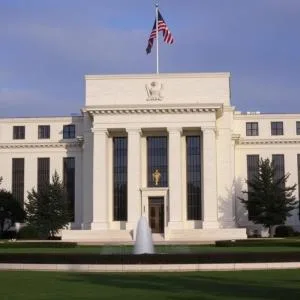
Bitcoin investors face renewed uncertainty as the Federal Reserve held interest rates steady while signaling a more hawkish trajectory in its latest dot plot projections. Although no immediate rate hike occurred, the Fed’s forward guidance suggests a cautious stance that could limit liquidity, a critical factor for risk-driven assets like Bitcoin.
The central bank’s updated outlook triggered market recalibrations because it indicated less willingness to cut rates soon, and possibly hinted at further hikes. This shift affects expectations for financial conditions worldwide, influencing how investors approach risk assets. Bitcoin, often seen as a high-beta asset sensitive to global liquidity changes, reacts accordingly when the Fed signals tighter policy.

Unlike traditional securities, Bitcoin’s price moves reflect macroeconomic variables such as real yields, dollar strength, and liquidity expectations rather than company fundamentals. A more restrictive Fed stance tends to reduce investor appetite for speculative positions, leading to cautious trading, outright deleveraging, or rotation into safer assets. Therefore, the dot plot’s projections carry disproportionate influence on Bitcoin’s trading context, despite no immediate policy adjustment.
The recent Fed meeting also marked the start of Kevin Warsh’s tenure as chair, introducing an element of uncertainty regarding future communication and policy emphasis. Market participants are attentive to how Warsh will balance inflation control, financial stability, and growth concerns. Early signals suggest a patient but firm approach, meaning Bitcoin may require stronger positive catalysts—such as increased spot ETF inflows, robust on-chain activity, or decisive technical price movements—to overcome the prevailing macro headwinds.
Traders should closely monitor bond yields, the U.S. dollar’s strength, and Bitcoin’s ability to maintain critical support levels. Effective ETF flows and easing macro pressures could stabilize Bitcoin’s price. Conversely, prolonged expectations of restrictive monetary policy may sustain pressure on leveraged positions within crypto markets.
The key insight remains that, while Bitcoin’s long-term value proposition is not directly tied to central bank actions, its short-term market dynamics are still heavily influenced by the Fed’s stance on liquidity and interest rates. This dynamic explains Bitcoin’s varied and sometimes uneven responses to Federal Reserve communications over time.