

Oregon’s job market showed no immediate improvement in May as the unemployment rate held steady at 5.2%, matching the rate from the first four months of the year. This rate stays notably higher than the national unemployment rate, which held at 4.3% over March, April, and May.
Despite a flat unemployment rate, Oregon’s nonfarm payroll employment experienced a seasonal boost in May, increasing by 3,600 jobs after an upwardly revised gain of 600 in April. Employment growth was concentrated mainly in the service sectors, with other services adding 2,000 positions and professional and business services contributing 1,800 jobs. In contrast, the manufacturing sector continued to contract, shedding 1,100 jobs in May, reflecting an ongoing decline over recent years.

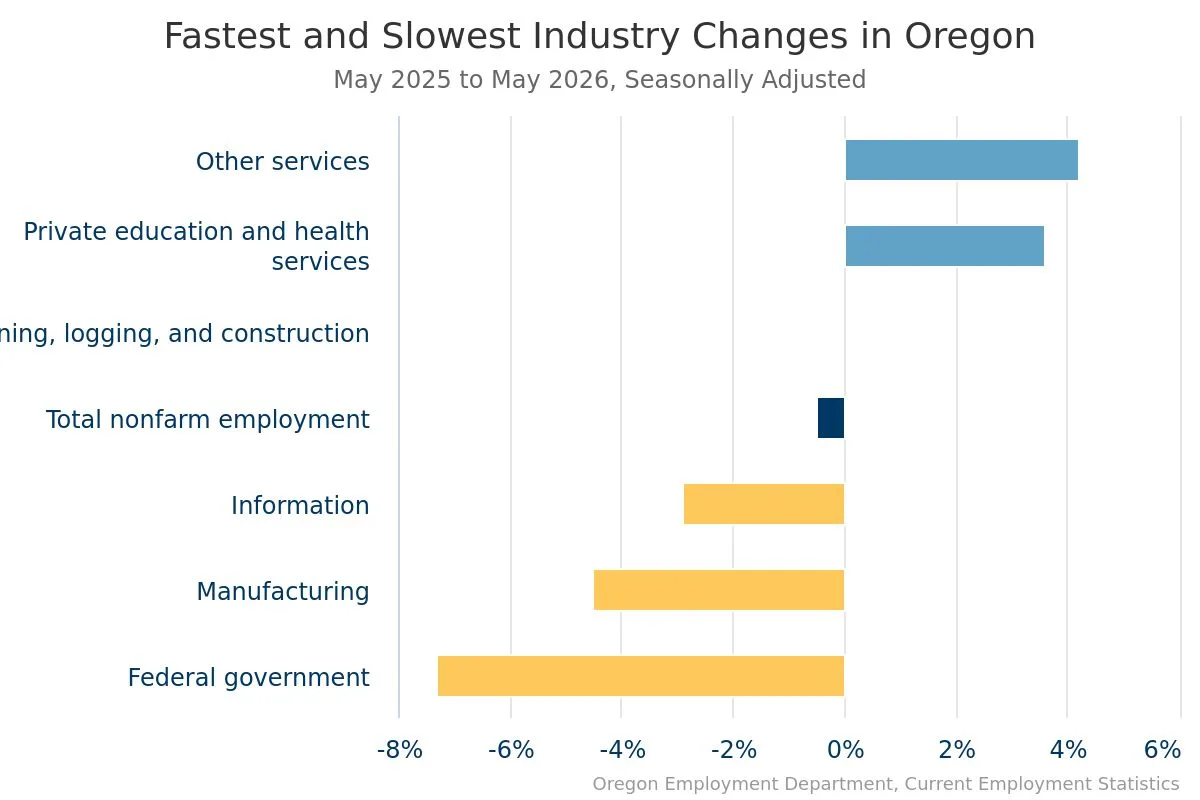
Although payrolls grew by a total of 4,200 jobs between April and May, this was insufficient to close the gap formed since last year. The number of nonfarm jobs in Oregon remains approximately 9,100 fewer than in May 2025, representing a 0.5% decline. Over the past year, job cuts impacted nine major industries, while only five saw employment increases.
Oregon’s total nonfarm payroll employment has lingered below two million jobs for four consecutive years, standing at 1,977,100 in May. This figure is down by 20,900 jobs from its peak of 1,998,000 recorded in September 2024. Growth in the health care and social assistance sector, which had expanded rapidly in prior years, appears to be slowing. Since October 2025, employment in ambulatory health care services and hospitals has leveled off, while nursing and residential care facilities and social assistance continue to expand, adding 1,500 and 4,600 jobs respectively.
Manufacturing remains a weak spot in Oregon’s labor market. Over the past 12 months, durable goods manufacturing has lost 5,900 jobs, a 4.7% reduction, while nondurable goods manufacturing cut 2,200 jobs, or 4.0%. These declines contribute to the broader challenges Oregon faces in recovering lost manufacturing employment.